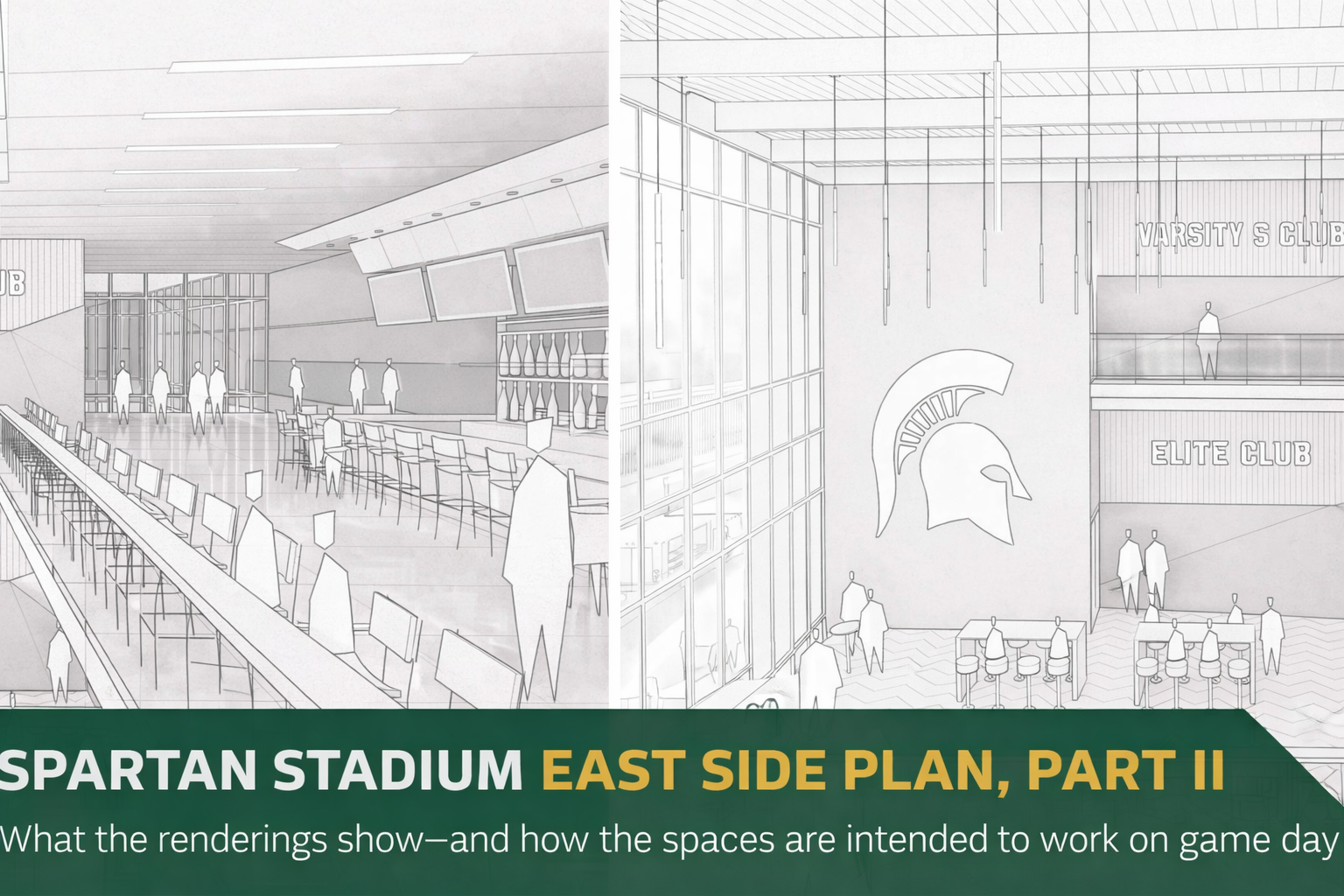
Part II (Photos): Inside Spartan Stadium’s east side renovation plan
Breaking down the preliminary layouts, levels, and spaces behind the renderings
Editor’s note: This piece is best read in conjunction with our earlier report, Inside Michigan State’s plan to rebuild Spartan Stadium’s east side, which outlines the project’s origins, timeline, funding framework, and broader strategic goals. That article provides the narrative and institutional context for what follows. The material below builds on that foundation, focusing more narrowly on the design concepts, spatial organization, and how to properly interpret the preliminary images and diagrams that have been released to date.
Big stadium renovations don’t arrive fully formed. The Spartan Stadium East Side Modernization Project begins with concepts - documents meant to establish scale, priorities, and direction - and evolves through months of design, coordination, and refinement before construction ever begins.
The most important thing to understand about these images is not what they show in detail, but what they signal in scale: they represent the opening move in an effort to fundamentally reshape how the building works, not simply how it looks.
As with any project of this magnitude, the conceptual renderings, floor diagrams, and isometric views released to date are preliminary.
The images shown here originate from Michigan State’s Athletic Facilities Master Plan and were included in the Request for Proposals (RFP) issued by the university to solicit bids for the east side renovation. Their purpose is to communicate overall scope, layout, and program priorities - not final finishes, dimensions, or configurations.
Once an RFP is issued and a construction manager is selected, projects of this scale follow a well-established progression. Master plan concepts are first translated into schematic design, where dimensions are tested, circulation (the paths and systems that move fans through the building, including entrances, concourses, stairs, ramps, and elevators) refined, and major building systems coordinated. That is followed by design development, when architectural details, structural systems, premium spaces, concourses, seating layouts, accessibility, and operations planning are more fully defined.
The process culminates in construction documents, which lock in layouts, materials, and systems and serve as the basis for actual construction. While finishes and details may continue to evolve even at that stage, the overall massing, circulation strategy, and program mix are largely set.
Viewed through that lens, these images should be understood as an early but meaningful snapshot of intent, not a promise of final form. As the design process advances, concepts will be refined through detailed architectural work, value engineering, and coordination with Michigan State University before construction proceeds on fully approved plans.
To continue reading, subscribe to Spartans Illustrated. The remainder of this article breaks down the Spartan Stadium East Side Modernization Project level by level, showing how more than 229,000 square feet of new and rebuilt space comes together - from expanded concourses and premium clubs to loge boxes, student social areas, broadcast operations, and improved vertical circulation. It’s a clear look at why this is a comprehensive rebuild of the east side’s internal framework, designed to fundamentally change the game-day experience for decades to come.