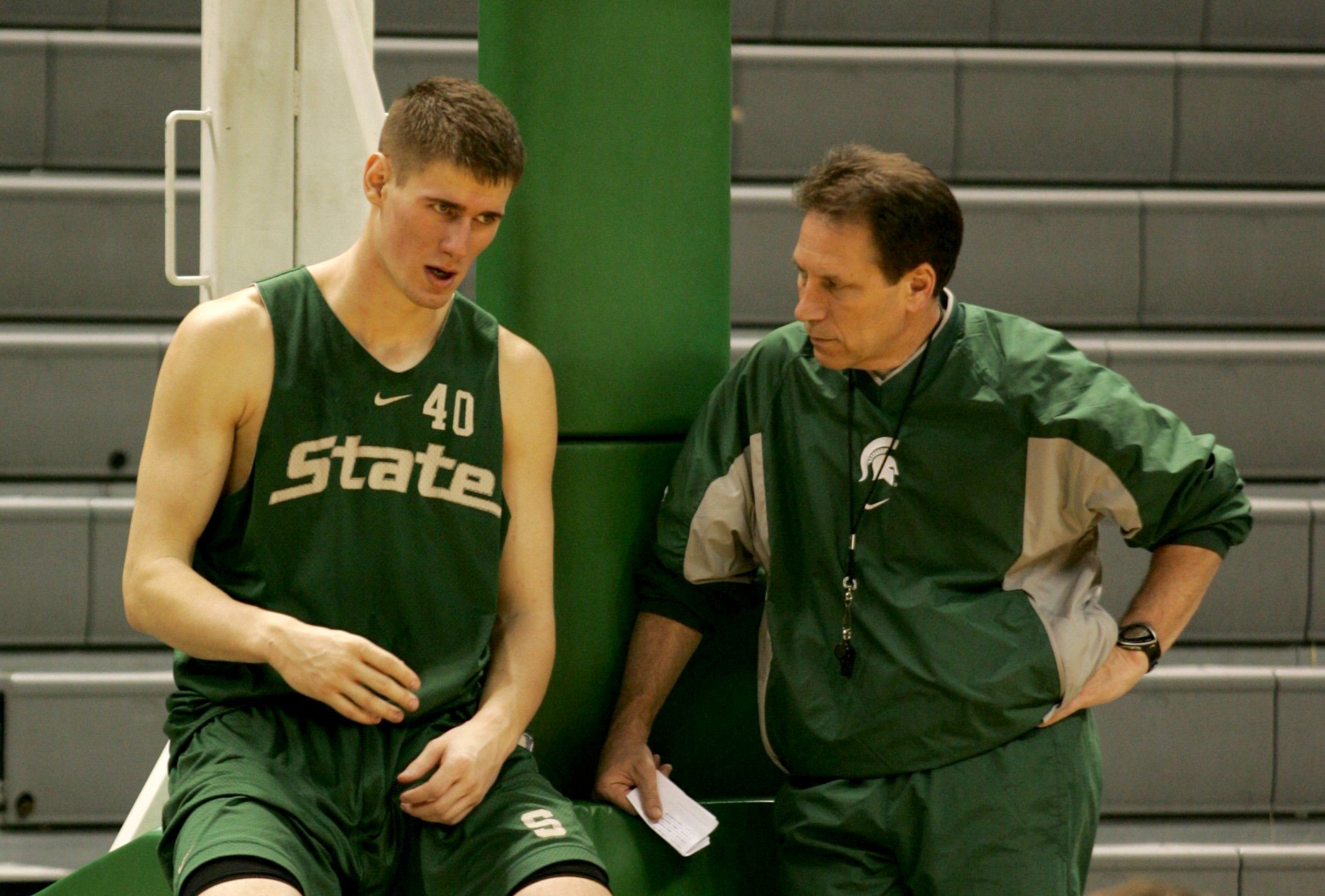
COLUMN: Tom Izzo and Paul Davis handled a bad moment the right way
Izzo didn’t protect. Davis didn’t hide. And that distinction matters.
Mistakes happen in public spaces now more than ever. What still feels rare is what happens after — especially when embarrassment is involved, reputations are on the line, and the easiest move is silence.
Monday night at the Breslin Center, former Michigan State big man Paul Davis crossed a line. After saying something offensive to one of the referees standing feet from him on the court, he was removed from the seating area near the court. The incident spread quickly on both social media and on news sites across the country.
In my opinion, though, what followed over the next 24 hours mattered far more than what caused it.
Tom Izzo has always preached family. He has always preached accountability. When given an opportunity out of the blue to put those values into action, he didn't hesitate.
This wasn’t about excusing behavior. It wasn’t about minimizing consequences. It was about accountability — real, uncomfortable, face-to-face accountability — and the standards Michigan State claims to value actually being enforced.
Tom Izzo didn’t dodge it. Paul Davis didn’t hide from it. And together, they showed what responsibility looks like when it’s taken seriously.
Izzo’s initial response was striking not for its defensiveness, but for its directness.
“What he said, he should never say anywhere in the world,” Izzo said, less than an hour after it happened, to a room full of media.
No hedging. No softening. He made it clear that Davis was wrong — “150 percent wrong,” in his words — and that the official was justified.
To me, that matters — because accountability collapses the moment leadership tries to blur the facts. Not all universities take this approach. Some obfuscate. In fact, some in leadership at Michigan State have failed in this arena in the past. That's why this reaction is so important.
At the same time, Izzo refused to do what modern outrage cycles often demand: turn a mistake into a permanent indictment of character. He drew clear boundaries — what Davis said was unacceptable — but he also contextualized who Davis has been for the program over decades. Not as a shield, but as a reminder that one failure doesn’t erase a full record.
That balance is difficult. It requires credibility. And it requires being willing to have hard conversations, privately and publicly.
Izzo didn’t push it off to a statement. He didn’t “handle it internally” and hope it disappeared. He said he would call Davis — and before he could, Davis called him first.
Less than 24 hours later, Davis stood in front of the media after Michigan State practice. No prepared statement. No PR buffer. No filtered questions.
“I’m not up here to make any excuses,” Davis said. “I’m up here to take accountability. To own it.”
He apologized — specifically and repeatedly. To the officiating crew. To the team. To USC. To the fans in the building. To alumni. To parents who brought children. To the university.
Davis did what the vast majority of Spartan fans wanted to see: stand up and take it - don't hide, don't cower, don't make excuses.
There was no attempt to reframe the moment as misunderstood or blown out of proportion. Davis didn’t argue intent. He didn’t ask for grace before acknowledging fault. He didn’t outsource blame to emotion, competitiveness, or circumstance.
He also didn’t minimize the impact. He acknowledged that, as a former player and visible alum, the responsibility doesn’t end when eligibility does.
“You’re an ambassador when you leave,” he said — and on Monday night, he failed in that role.
That acknowledgment is the difference between apology as performance and apology as responsibility.
One of the more revealing parts of the press conference came when Davis explained why he wanted to speak publicly at all.
It wasn’t to repair optics. It wasn’t to get ahead of criticism. It was because he believed accountability should be visible — especially to younger players and fans watching how adults handle mistakes.
That idea was echoed by Izzo, who emphasized that the true measure of a person isn’t the mistake itself, but how they respond afterward. Izzo even turned the lens on himself, recounting moments earlier in his career he now regrets, underscoring that self-evaluation doesn’t stop with age or authority.
What made this moment credible is that neither man treated it like a branding opportunity. No slogans. No moral victory lap. Just acknowledgment, apology, and resolution. They handled the issue, learned from it, and made clear it shouldn’t be repeated.
In an era where public figures are incentivized to disappear until the next news cycle resets, this stood out.
Not because the behavior was admirable — it wasn’t — but because the response was deliberate, uncomfortable, and human.
This wasn’t about canceling or protecting. It was about standards.
Michigan State didn’t pretend nothing happened. Davis didn’t pretend it wasn’t serious. And Izzo didn’t pretend leadership means insulation from criticism. They addressed it directly, then moved on.
That’s not a spectacle. It’s not viral. But it’s how accountability is supposed to work.
And in college athletics — where words like “family” and “culture” are often used casually — this was one of the rare moments where those ideas were tested publicly and held up under pressure.
As he usually does, Spartan fan M.L. Elrick wrapped it up clearly: "Yesterday, I was embarrassed that Paul Davis was a Spartan. Today, I am proud he is a Spartan. It’s too easy to be a fool. It’s way harder to face it like a man. Davis, like he did as a player, stood tall and did the hard part. He talked about being a role model. I think he became a good one today."