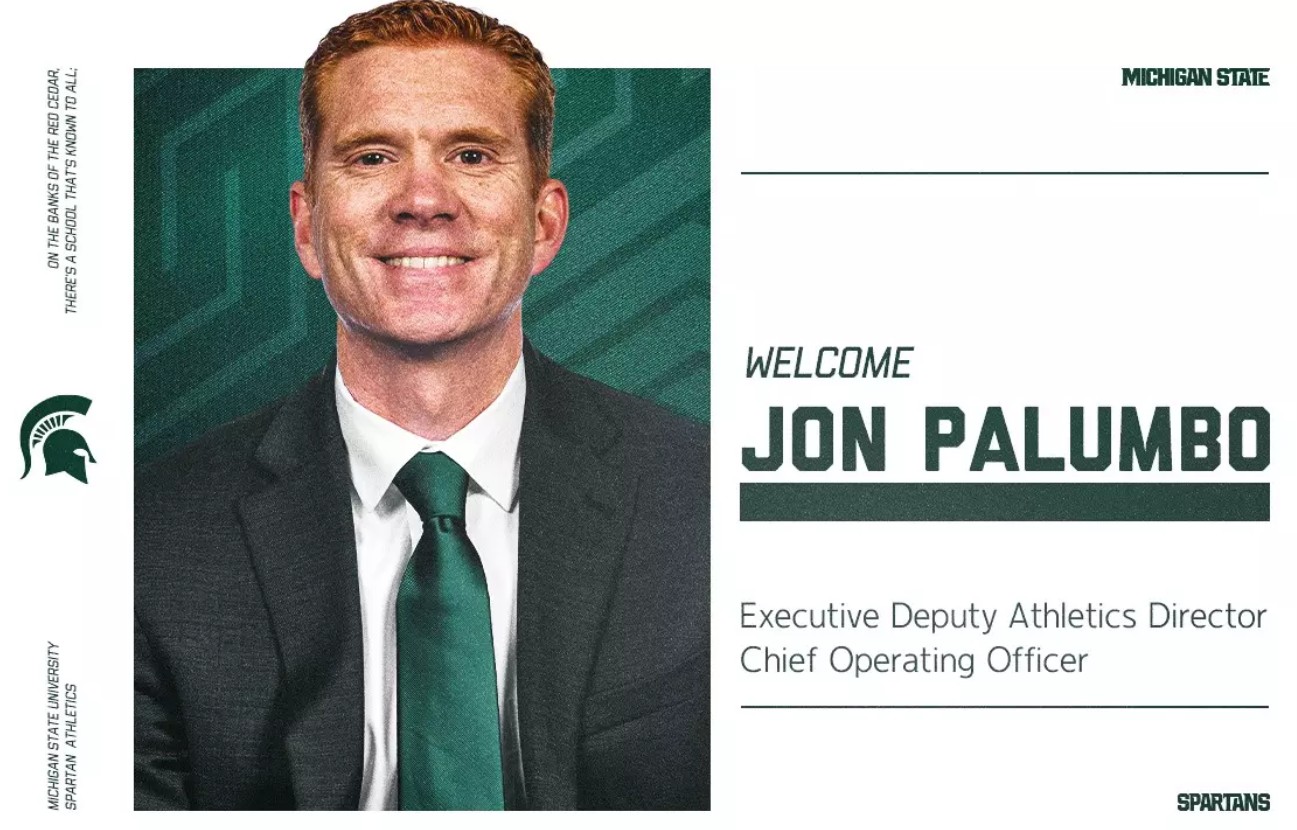
MSU Deputy AD Jon Palumbo will be the CEO of Spartan Ventures
Source confirms Palumbo will lead the nonprofit entity created to expand Michigan State’s athletics revenue strategy
letics business entity.
As first reported Thursday by The Detroit News, Jon Palumbo — Michigan State’s executive deputy athletic director and chief operating officer — will be the chief executive officer of Spartan Ventures when it launches several months from now. The reporting was first published by Detroit News reporter Sarah Atwood.
A source familiar with the structure confirmed to Spartans Illustrated this evening that Palumbo will lead Spartan Ventures, placing one of Athletic Director J Batt’s closest deputies in charge of the organization as it prepares for its anticipated launch in summer 2026.
Michigan State has not yet clarified how Palumbo’s leadership role with Spartan Ventures will intersect with his current responsibilities inside the athletic department.
What Spartan Ventures Is Designed to Do
Michigan State’s Board of Trustees authorized the creation of Spartan Ventures — and its subsidiary corporation Spartan Athletics Foundation — in October 2025 as a nonprofit, tax-exempt organization affiliated with, but legally separate from, the university.
According to Michigan State Athletics’ announcement at the time, the entity was established to:
Expand revenue-generating opportunities connected to athletics
Support NIL opportunities for student-athletes
Modernize engagement with corporate partners and donors
Introduce private-sector operational flexibility while maintaining institutional oversight
“College athletics is evolving rapidly, and this model allows Michigan State to remain proactive,” Batt said when trustees approved the affiliation agreement.
The structure is designed so that Michigan State retains control over athletics operations — including teams, facilities, compliance, and academics — while Spartan Ventures focuses on commercial partnerships, revenue development, and new business initiatives.
Governance Structure
Spartan Ventures is overseen by a seven-member board of directors that combines university leadership with private-sector executives.
The board includes:
Restaurateur Phil Hickey (chair)
MSU Athletic Director J Batt
MSU President Kevin Guskiewicz
MSU Board of Trustees Chair Brianna Scott
MSU Federal Credit Union CEO April Clobes
Technology entrepreneur and private investor Rick Lasch
Zeigler Auto Group President Aaron Zeigler
The board’s responsibilities include long-term strategic oversight, fiduciary governance, risk management, and the hiring and evaluation of the organization’s chief executive.
With Palumbo now identified as CEO of Spartan Ventures, the board’s next phase of work will center on overseeing Spartan Ventures as it moves toward operational launch.
The For-Profit Subsidiary
Spartan Ventures will also oversee Spartan Media Ventures (SMV), a for-profit subsidiary intended to manage certain commercial activities tied to Michigan State’s athletics brand.
During the Dec. 12 Board of Trustees meeting, members voted to authorize MSU President Kevin Guskiewicz to enter into the Strategic Brand Management Agreement tied to Spartan Ventures. The resolution passed by a 5–3 vote. Trustees Michael Balow, Rema Vassar, and Dennis Denno voted against the measure. All three indicated they generally supported expanding revenue opportunities for athletics but said they had not yet reviewed all of the legal and financial documents connected to the arrangement.
The trustees also acknowledged Greg and Dawn Williams during the meeting. Their $401 million gift to Michigan State — the largest single donation in university history — includes $100 million designated for the Spartan Ventures initiative. The resolution approved that day allows the university to move forward with agreements enabling the two entities to operate together.
Where Spartan Ventures Fits Nationally
Michigan State’s creation of Spartan Ventures reflects a broader transformation unfolding across college athletics.
Public universities are increasingly facing financial and structural pressure from several forces, including:
NIL compensation markets
Transfer portal mobility
Athlete revenue-sharing frameworks
Rising coaching salaries and operating costs
Athletic departments originally built for a nonprofit, amateur sports model are now operating in an environment that increasingly resembles professional sports economics.
In response, many universities have begun developing hybrid governance structures that separate commercial business activity from the university’s core academic and athletic operations.
Michigan State’s approach places revenue-generating activities under the nonprofit Spartan Ventures umbrella while allowing a related for-profit subsidiary — Spartan Media Ventures — to handle certain commercial ventures such as media, sponsorships, and brand partnerships.
The intent behind such structures is to allow faster business decision-making, attract outside investment, and isolate commercial risk while the university maintains control over athletics governance.
Michigan State officials have repeatedly emphasized that the university retains authority over teams, facilities, compliance, academics, and competitive decisions. Spartan Ventures is designed to function as a business-focused partner entity rather than a replacement for the athletic department itself.
Remaining Questions
Several operational details about Spartan Ventures are still being finalized.
University officials have previously indicated that it remains under review which specific functions — such as ticketing operations, sponsorship sales, or other revenue activities — may eventually move from the athletic department to the new structure.
Another open question is how Palumbo’s leadership of Spartan Ventures will interact with his existing role inside Michigan State Athletics.
Still, his identification as CEO suggests Spartan Ventures is moving beyond the planning phase and toward full implementation.
While questions remain about how Spartan Ventures will ultimately operate, the debate surrounding the organization reflects a much larger shift occurring across college athletics. Universities nationwide are grappling with how to compete in an increasingly commercialized environment while still operating within public governance structures designed for a very different era.
The Structural Reality Public Universities Are Navigating
Nearly every major public university operates through a network of legally distinct entities.
University foundations raise and manage vast sums of money outside the core university budget. Research institutions commercialize patents through separate corporations. Athletic departments routinely outsource multimedia rights, sponsorship sales, and licensing to private-sector partners.
These structures exist because public universities operate in two worlds at once. They are public institutions subject to oversight and transparency requirements. At the same time, they are economic enterprises competing in markets that move at private-sector speed.