Lamp posts, long shots, and blind faith: How Blake Sislo kicked his way to Michigan State
When Sislo entered the transfer portal, no one was interested; but that didn't stop him from following his dream.
On summer nights in East Lansing, when campus quiets and the stadium lights sit dark, the rugby fields and practice spaces usually empty out. But for months, one figure kept showing up alone: a kicker with no team, no guarantee, and no real reason to believe a door would open — except that he refused to stop trying.
Sometimes the goalposts were locked behind fences. Sometimes they were taken by soccer leagues or practices he didn’t even know existed. Sometimes, there were no posts at all.
So he improvised.
He kicked at lamp posts.
He kicked in the dark.
He kicked after shifts at a boat yard, soaking wet or bone-cold or mentally exhausted. He kicked because when he entered the transfer portal, the warnings came fast: Most kickers don’t make it out.
He kicked because he’d already bet everything on himself. And he kicked because he had a vision so specific he could picture the font of his last name on the back of the jersey.
He kicked because he wanted to be a Spartan.
This is the story of Blake Sislo — born in Dexter, Michigan, shaped at Davenport, hardened in anonymity, and refined at Michigan State — who turned a self-made, often lonely path into three games in the Big Ten, six made point-after-touchdown (PAT) attempts, a kickoff, and a locker at Spartan Stadium with his own name on it.
It’s the story of unglamorous persistence — the kind that happens when nobody is looking.
When Sislo first committed to Davenport, he wasn’t thinking about Michigan State. He wasn’t even thinking about Power Five football. He was thinking about opportunity — any opportunity.
“I was simply grateful to have an opportunity to play football again,” Sislo told Spartans Illustrated. “But I always knew I wanted to play at a higher level.”
That duality — gratitude mixed with long-term ambition — defined his earliest college days. He envisioned Davenport as both a restart and a proving ground.
Get better. Get reps. Grow. Then see what could happen.
But the proving ground proved harsher than expected.
Heading into his second season, he had a real shot at the starting job. Then the program brought in a transfer. Then he got hurt. That small window cracked open for someone else, and just like that, the job he expected to have was gone.
“It made me look at life in a different way,” he said. “If anything, it fueled me to work harder.”
According to Sislo, no single coach or teammate changed him during his Davenport years. If anything, it was the absence of that support that shaped him.
“I would say it was always the feeling of being overshadowed that shaped me,” Sislo said. “At the D2 level they’re always looking for the best player and they’re never going to settle. I never had many friendships there because it was so highly competitive.”
He learned something foundational: nobody was going to hand him anything.
If there was one player who cracked the door open toward belief, it was the very man who took the Davenport job from him — a kicker who began getting NFL looks.
“I didn’t consider myself very far off from him,” Sislo said. “So I said instead of sitting behind him, let’s take a risk and move on.”
But the moment he truly believed he could play at a higher level came years earlier, at camps where he’d compared himself to top high school specialists.
“I realized I could actually compete,” he said. “That made me think I should start taking this kicking thing seriously.”
That confidence carried him into the transfer portal, where reality hit fast.
He received no attention.
No serious interest.
No offers.
A kicking coach even warned him: Going into the portal is dangerous. Most kickers never come out.
Sislo went in anyway.
The leap of faith wasn’t blind — not to him. But from the outside, it looked that way.
The vision was Michigan State. The method, however, was chaos.
Most nights after lifting, he drove around East Lansing looking for a field. Often, he couldn’t find one. One night stands out vividly.
“All the high school fields around East Lansing were taken," he recalled. "The rugby field was taken. The IM fields were all taken by indoor soccer leagues. I didn’t know what to do.”
So he drove. For nearly half an hour.
Finally, he spotted a rec field near IM East. No posts. No hash marks. Just a lamp post.
“I decided to just find a flat part and work on my accuracy by kicking at a single lamp post,” Sislo said.
And as he lined up his makeshift target, a thought hit him hard: "Am I crazy?"
Followed immediately by another: "Who else is trying this hard just to walk on to a team they might not even get a chance to get onto?"
That blend of doubt and defiant belief became the constant rhythm of his transfer year.
“I never knew if I’d even get the opportunity,” Sislo said. “But I knew I was going to try everything I could.”
It didn’t happen at a workout, or after sending film, or on the field at all.
It happened at work.
Sislo was helping move kayaks at a boat yard when he missed a call. When he finally checked his phone after his shift, he saw a message: “Hey, this is Coach Begnal from MSU. Give me a call.”
He dialed immediately.
Joe Begnal — who was the assistant special teams coordinator at MSU — told him Michigan State wanted to bring him in for fall camp.
No promises. No guarantees. But a real shot.
“To say I was excited would be an understatement,” Sislo said. “Everything I’d been working for since I started kicking nine years ago … it was indescribable.”
But the truth is, that moment only happened because Sislo had already forced himself into MSU’s orbit.
He went to a specialist camp that summer. He performed. Begnal asked for his Twitter handle afterward — nothing official, but enough to spark hope.
And long before that, he and his dad, Mike, were doing something few people know: They would stand outside the MSU football building together, multiple times, trying to get the coaches’ attention.
Mike played defensive back for Michigan State under George Perles from 1992 until 1994.
“We were turned down a couple times,” Sislo said. “But without my dad, I don’t think I’d be in the position I am today.”
His brother also played a small but pivotal role — approaching a coach in the football building the day of the camp to ask where the special teams coach was so Blake could introduce himself.
“If he hadn’t done that, I don’t think I’d have gotten the opportunity to walk on,” Sislo said.
It wasn’t just Blake’s grind. It was a family effort.
When Sislo arrived for fall camp, he wasn’t walking into hero status.
“I was the guy who would take the scout kick reps,” he said.
A few field goals here and there. Lightening the load for the veteran kickers. Learning, watching, absorbing.
But then injuries hit the specialist room.
Openings emerged. Small ones at first. A few reps. A few chances. A chance to show he belonged.
The moment he knew he’d won trust came during one of the first scrimmages at Spartan Stadium. He hit his first three kicks, missed his fourth, then was moved back to 50 yards on the right hash.
What happened next became a part of team film study.
“I hit a really good ball that would’ve been good from 56 to 58 yards,” Sislo explained.
After practice, Begnal approached him.
“He told me how big of a kick it was, that it gave them confidence I could make kicks,” Sislo said.
The next day, the staff showed that kick in a team meeting, praising him in front of the entire program.
“That really gave me confidence, knowing the coaches had confidence in me," he said.
It also helped that he had teammates who mentored him immediately: Tarik Ahmetbasic, Martin Connington, Ryan Eckley and Carson Voss.
“Carson helped me get integrated," Sislo said. "Tarik and Martin helped me tremendously with technique. Ryan gave me the most confidence. He never let me get down on myself.”
Step by step, rep by rep, the self-taught kicker became a Big Ten player.
Being self-taught created some deeply ingrained quirks. The hardest one to fix: Kicking too high up on his foot.
“I was hitting the ball closer to my ankle,” he said.
MSU widened his steps and adjusted his plant foot to force cleaner contact.
Small changes. But monumental.
Many would think the biggest mental hurdle jumping to the Big Ten would be the crowds, the spotlight, the scale of everything.
Not for Sislo.
“None of that really bothered me,” he said. “If anything, it made me more excited.”
The real challenge was internal.
“I had to learn it was OK to make a mistake,” he said. “I was so worried about making kicks that I didn’t allow myself to learn.”
Camp taught him to let go. Miss, correct, move on. The maturity he gained at Davenport helped.
It wasn’t a practice rep. It wasn’t the scrimmage kick. It wasn’t even making the travel roster.
The moment it became real was when he saw a locker.
Specifically, his locker.
The pads. The jersey. The nameplate. The colors he’d worn on video games as a kid.
Seeing "SISLO" stitched onto a Michigan State jersey for the first time hit him harder than anything else.
“There’s something real special about seeing your last name in those specific colors, in that specific font,” Sislo said. “It really made me feel like my dreams were coming true.”
He snapped a photo immediately.
He sent it to three people that day: his girlfriend, his mom, his dad. The three constants in his entire journey.
Before his first game, his dad sent him a GIF — just like he had before every game in high school.
A hyped-up Ray Lewis clip.
Three words: "It’s game day." And more advice from his father helped him to focus.
“He also told me to just enjoy it,” Sislo said.
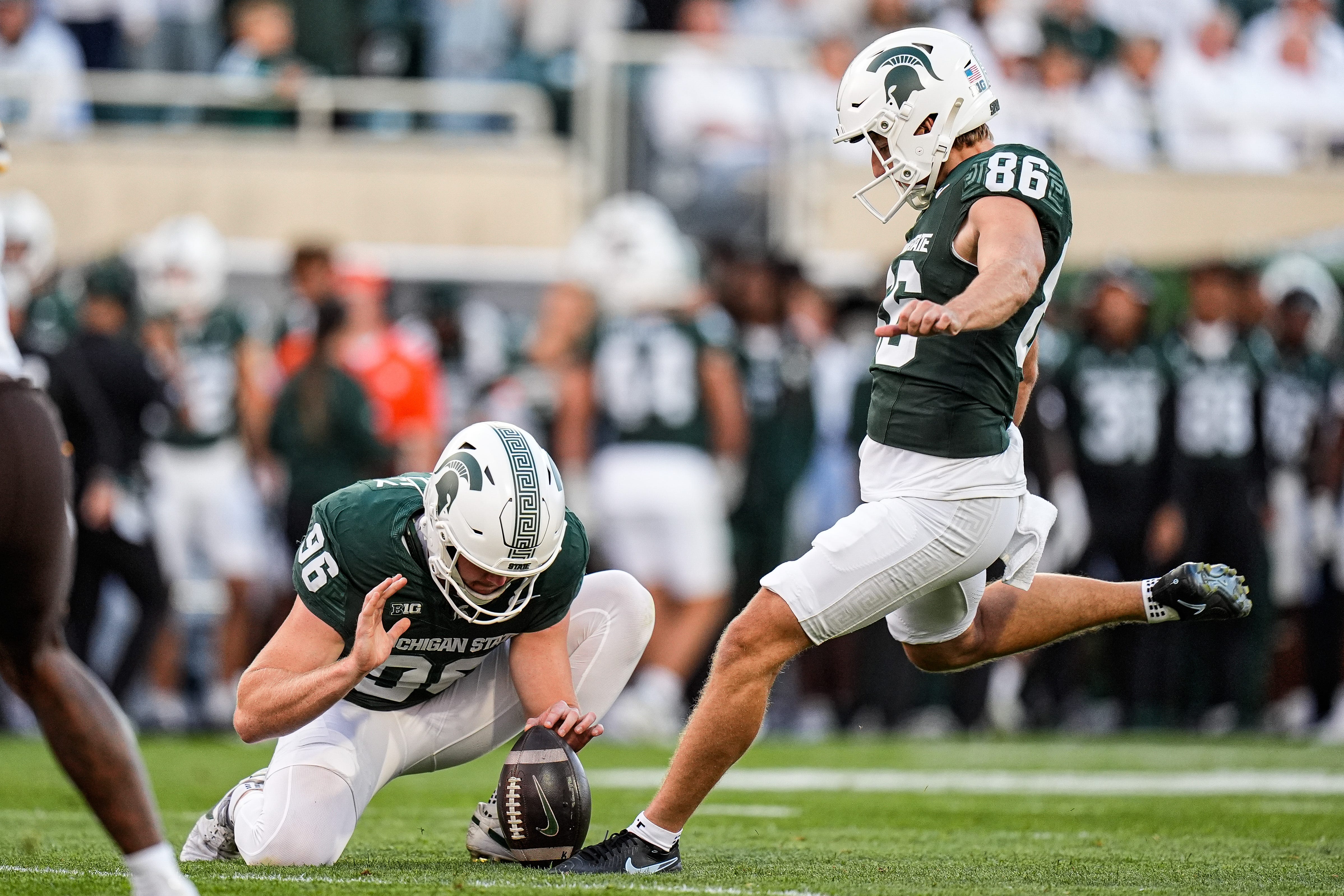
Sislo played in the first three games for Michigan State in 2025.
He attempted six PATs. He made all six. He kicked off once. The returner fair caught it.
“I would say overall I had a successful time when I was put into the game," Sislo explained.
If there’s one image that captures who Sislo is — not the MSU version, but the core version — it’s this:
Rain. 40 to 50 degrees.
Hands numb. Feet numb.
Only a single ball. A high school field.
A 45 to 50-yard attempt he kept missing.
“No one was around," Sislo said. "No reason for me to stay."
But he refused to leave until he made it.
He stayed. He kicked. He made it.
That was the habit that carried him from obscurity to Spartan Stadium: Doing the right thing when no one is watching.
For all the grind and loneliness of the journey, the destination surprised him.
“Michigan State felt more like a family,” he said. “People were very nice from day one. It built a bond in one year greater than any connection I had in three years at Davenport.”
It mattered. More than he expected.
Sislo doesn’t see his story as a miracle or a blueprint.
He sees it as a philosophy.
“You don’t have to be the most popular or well-known individual to have your dreams come true,” he said. “You just have to be willing to work harder than those who may get more attention.”
And one more warning for young athletes: “You never know when you’re going to get your opportunity — and when you do, you better be ready, because you may only get one shot.”
If you had wandered past IM East on that night when he was kicking at lamp posts, you might have seen a lonely figure and assumed he was wasting his time.
But that night wasn’t wasted.
And neither were the hundreds like it.
Those nights built a Spartan.
Those nights earned a locker nameplate.
Those nights created six made PATs in the Big Ten.
Those nights made this story possible.
And they made Blake Sislo exactly the kind of player Michigan State has always valued:
A worker. A grinder. A believer.
Someone who earned every inch — one lamp post at a time.