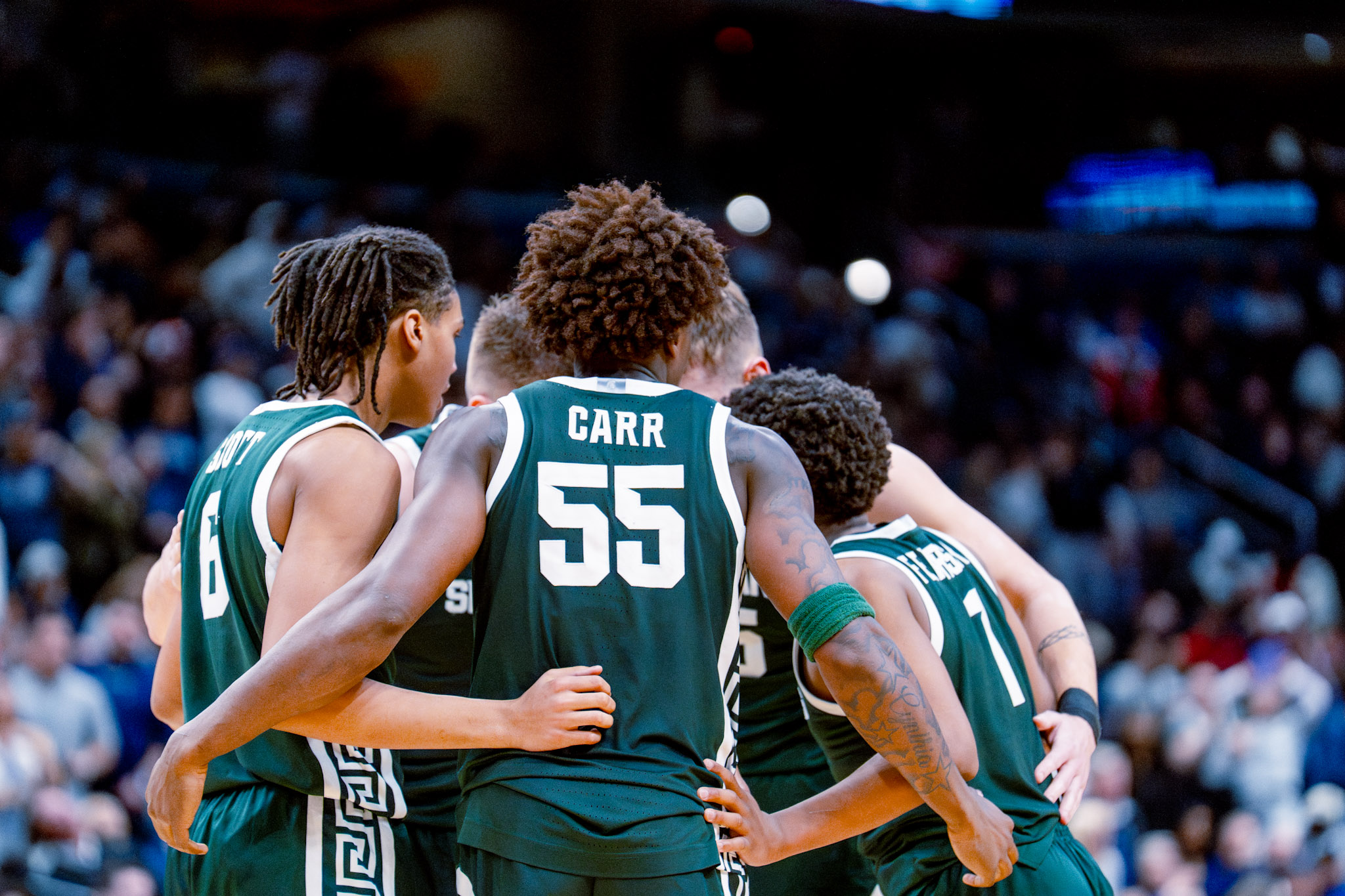
INSIDER: How to understand Michigan State’s approach to the transfer portal
What the Spartans are actually prioritizing as they look to add this offseason
As the transfer portal opens and the annual frenzy ramps up, the conversation around Michigan State has already started to drift toward the same familiar place.
Who is the big target? How much will it cost? And if the Spartans do not land the most obvious or most hyped name, does that mean Tom Izzo and his staff are not pushing hard enough?
That is the easy version of the discussion.
It is also the least useful one.
The more revealing story is not whether Michigan State wants to improve its roster. Of course it does. The more revealing story is how the staff is trying to improve it in a way that actually strengthens the program instead of simply satisfying the mood of portal season.
That distinction matters, because Michigan State is not approaching this like a team trying to reinvent itself overnight. It is approaching it like a program that believes it already has a foundation worth protecting, a roster worth developing, and a culture worth preserving even as the sport around it becomes increasingly transactional.
That does not mean the Spartans will sit still. It does not mean they will avoid the portal out of principle. It does not mean they are blind to areas that need help.
It does mean they are trying to thread a difficult needle.
Michigan State is expected to make an addition to the frontcourt, and that should surprise no one. But even there, the thought process inside the program is more layered than many outside conversations allow.
The goal is not just to locate a center-sized body, plug him in, and declare the problem solved. The staff has to evaluate whether that player actually fits the way Michigan State wants to play, whether he can hold up physically in the Big Ten, whether his movement and instincts translate, whether his personality and approach work in the locker room, and whether the cost – in every sense – makes the move worthwhile.
That last part is where the public conversation often loses the plot.
Portal discussions are usually reduced to a kind of fantasy shopping exercise, where the only visible questions are who is available and how much money it would take. But actual roster building is more complicated than that. Every addition affects minutes. Every addition affects roles. Every addition affects development. Every addition sends a signal to the players already on the team about what the staff believes, what it values, and how quickly it is willing to move on from people it has already invested in.
That is one reason Michigan State’s staff has remained more deliberate than some fans would prefer. It is not just evaluating players. It is evaluating ripple effects.
The Spartans are not building from zero. They already have pieces they believe can help them. They already have young players they think are still growing into bigger roles. They already have a framework they believe can win at a high level. So while the outside world tends to talk about portal season as if every returning player should be treated as disposable until a shinier option appears, that is not how Michigan State will operate.
And frankly, there is logic to that.
Programs can absolutely improve through the portal. Michigan State knows that. It also knows there is a difference between supplementing a roster and destabilizing one. The challenge is finding help without creating new problems in the process – bringing in a player who elevates the team during the season, not just the conversation around it in April.
That is why evaluation, for a staff like this one, goes beyond stats.
Production matters. Size matters. Experience matters. But those things are only the beginning. How does the player move? How quickly does he get off the floor? Can he run? Can he defend in space? Can he process what is happening around him? Can he function in a structured system? Does he have a motor that holds up over time? Does he make the team more connected or more fragile?
Those are not glamorous questions, of course, but they are the ones that determine whether a portal addition actually works.
And that is where Michigan State’s approach remains notably different from the loudest outside demands. The staff is not looking at this as a pure bidding war in which the only winning move is to throw the largest bag at the most coveted name and sort out the consequences later. The evaluation is still rooted in basketball fit, personal fit, and program fit. There is still an effort to understand who the player is, what kind of environment he is coming from, what kind of role he expects, and whether the reality of Michigan State will match what he thinks he wants.
That is not outdated thinking. In a lot of ways, it is the only protection a staff has in a chaotic market.
Because this is the part of portal season that often gets ignored: the highest-priced answer is not always the best answer, and the most talked-about target is not always the cleanest fit. A player can look perfect in a stat line or in a social media graphic and still be wrong for a specific roster, a specific locker room, or a specific coaching staff. Michigan State is trying to avoid that trap.
It is also trying to avoid another one – recruiting over its own roster so aggressively that it damages the very structure it is trying to improve.
That does not mean the Spartans are promising anyone anything. That is not how good programs work. Players still have to earn roles. Competition still matters. If someone is not good enough, not ready enough, or not serious enough, that gets sorted out too. But there is a difference between healthy competition and reckless replacement, and Michigan State is trying to stay on the right side of that line.
That matters in a program that still believes development should mean something.
For all the noise around college basketball right now, Michigan State still sees value in continuity, in teaching, in players growing over time, and in the idea that not everyone becomes who they are going to be on the same schedule. Some players arrive ready for major minutes. Some do not. Some need strength. Some need polish. Some need repetition. Some need patience. A program that forgets that too quickly can end up chasing the portal every spring not because it is ambitious, but because it has stopped building anything sturdy enough to last.
Izzo’s staff clearly does not want that.
There is also a larger point worth making here, because it helps explain why Michigan State does not seem interested in treating NIL/rev share as the only thing that matters.
The Spartans still believe the program itself has value.
That value shows up in the visibility of the program, in the home environment, in the coaching, in the structure, in the expectation level, in the daily experience, and in the long-term credibility that comes with succeeding at Michigan State. None of that erases the importance of money. None of that means players should not be compensated. But inside the program, there is still a real belief that coming to Michigan State adds something to a player’s value – and that not every decision should be made as if the highest financial bid is the only persuasive argument left in the sport.
Whether fans agree with that or not, it is clearly still part of how Michigan State sees itself.
And in fairness, that viewpoint is not disconnected from reality. The Spartans are not operating from a place of irrelevance. This is a program that has remained nationally significant, that continues to develop players, that continues to matter in March, and that still offers a basketball life a lot of players would want to step into. The idea that Michigan State has nothing to sell beyond cash is simply not how the people inside the building see it.
That does not mean they are naive about the modern game. It means they are trying not to lose themselves inside it.
So yes, Michigan State will look for help. It should. It will add. But when that move comes, the fairest way to judge it may not be against the biggest rumor, the most expensive fantasy target, or the loudest online demand.
The fairer standard is whether the addition makes sense.
Does he fit the roster? Does he strengthen the rotation? Does he help the Spartans become tougher, more stable, and more complete? Does he make sense alongside the pieces already in place? Does the price reflect a real answer instead of a panic move? Does the addition help Michigan State stay competitive without asking it to abandon the program logic that got it here?
Those are the real questions.
And they are probably more important than whether the eventual name of the new center addition wins the first round of April applause.
Because portal season appears to reward headlines before it rewards results - and Michigan State is trying to resist that. The Spartans are looking for help, but they are trying to find the right help – not just the most obvious help, not just the most expensive help, and not just the help that plays best on message boards and social media for 48 hours.
That may not satisfy everyone. It may never satisfy everyone. But it is the clearest explanation for what Michigan State appears to be doing right now.
The Spartans are not ignoring the portal. They are not pretending the sport has not changed. They are simply trying to operate with a little more discipline than the conversation around them.
And in this era, that may be one of the hardest things for any program to do.