How a father/daughter relationship was the key to MSU Athletics' supercharged future
A father–daughter bond, a family’s belief in MSU, and a record-shattering $401M gift that will shape generations of Spartan stories
Friday morning at the Breslin Center felt familiar - the same arena where Spartans had celebrated buzzer-beaters and blowouts, thrilling victories and painful defeats - yet unmistakably different.
A fanfare unit of the Spartan Brass launched into the MSU fight song as the cheer team and hundreds of fans rose to their feet, applauding the guests of honor walking onto the Breslin Center floor through the tunnel normally reserved for visiting teams. Greg and Dawn Williams - the couple behind the largest gift in Michigan State University’s history, by nearly tenfold - took their seats in the front row.
For Greg, who has entered this arena hundreds of times and sat courtside as a benefactor, the moment carried him back to a very different walk into Breslin.
One not as a CEO or as a donor.
But as a dad.
A dad trying to connect with his teenage daughter.
Greg Williams and his daughter had reached that familiar stage where many parents and teenagers eventually find themselves: the friction years. The years when every conversation feels sharp, every misunderstanding feels bigger than it should be, and the two people who love each other most somehow keep knocking into each other at every turn. Things get strained. Quiet in the car, tense at home, crowded with all the unspoken things neither quite knows how to say.
Every parent has been there.
But, to hear Greg tell it, something changed for the Williams family - almost magically - every time they walked into the Breslin Center for a women’s basketball game.
His daughter loved women’s basketball, and for a couple of years, during the hardest stretch of those teenage battles, the one place Greg and his daughter could talk - really talk - was inside that arena. Something about the rhythm of the game, the pulse of the crowd, the bright simplicity of sitting shoulder-to-shoulder without the pressure of home dissolved everything that felt heavy.
Greg didn’t know why. He never pretended to understand it. He just knew that once they found their seats, the tension eased. Women’s basketball games became their truce. Their meeting ground. Their safe space.
So they kept going back. Game after game. Season after season.
For two years, those nights at Breslin became the few hours when the strain lifted, the stress softened, and the walls between them disappeared. They’d watch the team, cheer together, talk about life, and leave feeling closer than when they arrived.
And that’s why, Greg says, the gift that was going to be announced this day meant more than most people realize. The Breslin Center wasn’t just where he watched great basketball. It was where he and his daughter rebuilt something fragile and important - where they learned and grew, together.
As the event was ready to begin, there was the low hum of anticipation, the soft clatter of cameras being positioned, and the sense that those in the building understood something extraordinary was about to unfold.
When MSU President Kevin Guskiewicz took the stage, the arena shifted from restless to reverent. He stepped to the podium with the ease of a man accustomed to high stakes, but even he could be seen savoring the moment.
This wasn’t just a press conference. It wasn’t a celebration of a single achievement or a ceremonial ribbon-cutting. This was something rarer - the kind of moment when a university sees its future expand right in front of it.
A Horizon Suddenly Wider
President Guskiewicz spoke of the Breslin Center’s legacy, of triumphs and ceremonies and memories. But quickly, he moved beyond the past. He spoke of the future with an urgency, reminding the audience that MSU’s $4 billion “Uncommon Will, Far Better World” campaign was never simply a fundraising effort; it was a declaration that Michigan State was ready to confront the world’s toughest problems head-on.
Cancer research. Climate-driven food insecurity. The unknown jobs and technologies of the next century.
He talked about rolling up sleeves, about a university defined not by its history but by its hunger. And then he shifted the focus to the couple seated near the front - Greg and Dawn Williams - and the warmth between the president and the Williams family became instantly obvious.
They were one of the first families he had met after accepting the presidency. They had welcomed him and his wife Amy with kindness and conviction. They had believed in the university’s vision from the start. And today, that belief had crystallized into something monumental.
Then he said the number - $401 million - confirming that which was rumored and bandied about on the sites that discuss such things before the general public learns of them - and adding an extra million on to the rumored total, for good measure.
“Michigan State’s largest private financial commitment ever,” he said. “One of the largest in the nation.”
It was clear - this wasn’t just money; it was an endorsement of the institution, of its people, of its values. It was a vote of confidence in MSU’s future, one that would echo across academic buildings, athletic complexes, and band fields for decades.
A Seed Planted 43 Years Ago
Next to the microphone stepped Vice President for University Advancement Kim Tobin, and her smile made it clear how deeply she felt this moment.
She reached backward in time, not to grand gestures but to showcase something beautifully humble.
Five dollars.
That was Greg and Dawn’s first gift to MSU in 1982.
A newlywed couple supporting the newly opened Wharton Center.
That small seed, Tobin noted, had quietly grown for four decades - shaped by love for the university, nurtured through relationships, and ultimately blossoming into one of the most extraordinary commitments ever made to a public university.
The picture was painted in full: their support of athletics, entrepreneurship, the Burgess Institute, the Broad College’s new Risk Management and Insurance Institute, the Marching Band, and the nation’s best mascot program, Sparty.
She made sure to emphasize something deeper: this was about people.
Relationships. Community.
The way the Williams family had woven themselves into the Spartan fabric long before headlines or dollar amounts. And then she turned the floor over to Athletic Director J Batt.
The Billion-Dollar Vision
When Batt approached the podium, it was with the posture of someone fully aware of the magnitude of the moment.
He didn’t mince words.
“You’d be hard-pressed to find a more impactful, singular moment in the history of MSU Athletics.”
He talked about the newly launched For Sparta initiative, a bold billion-dollar master plan to transform Michigan State Athletics. Renderings released earlier in the week had gotten fans excited - but also skeptical.
Can we really do this?
Batt looked out at the Williams family and answered on behalf of the entire department: Yes. Yes, we can.
Of the $401 million, an astonishing $390 million was directed toward athletics. Facilities. Student-athlete support. Competitive excellence. Long-term stability in a college sports environment that is shifting daily.
A hundred million of that would be invested strategically through Spartan Ventures, positioning MSU to adapt quickly, boldly, and intelligently to the rapidly evolving world of NIL, athlete support, and college athletics economics.
“This ($100 million) will supercharge the revenue generating portion of Spartan Ventures,” a source told Spartans Illustrated after the event was over. The source declined to elaborate, but the message was clear - even though Spartan Ventures isn't set to launch until July 1, 2026, it is a key piece of MSU Athletics' future - and this start up money was essential to its success.
Sources also told Spartans Illustrated that when Batt was hired, the idea was to look at Michigan State Athletics with more of a corporate vision. Quicker than a university. More nimble. Able to make adjustments to an ever-shifting collegiate as they occur. And that is what is happening in East Lansing.
Then, with a tone that matched the stakes, he said what everyone in the building understood: Some athletic programs will evolve, some will not.
Michigan State, with this commitment, had chosen evolution at rocket speed.
Batt also spoke personally, reflecting on his first six months in East Lansing. Greg and Dawn were among the people who had helped him understand the Spartan family, the culture, the responsibility. His gratitude was palpable. And then it was Tom Izzo time.
The Hall of Famer and the Brush Hog
Izzo walked onstage to cheers, laughter, and a familiarity that felt like home. Then he shifted into storytelling. Izzo doesn't usually write out his speeches – but he did for this event. He didn't want to miss anything, which was ironic when he forgot to do the main thing he was up there for – introduce Greg Williams as the next speaker. In true Izzo fashion, though, it was emotional, funny, gritty, humble, and deeply human.
He told the Walnut Hills story.
Williams, a Laingsburg native and the CEO of insurance and financial technology giant Acrisure, bought the old Walnut Hills Country Club on East Lansing’s north side in late 2020.
The property sits not far from Tom Izzo’s neighborhood.
One day, Izzo noticed Dawn Williams using a large lawn mower – a brush hog as Izzo repeatedly referred to it – to clear the long-overgrown fairways as the couple began transforming the former golf course into their home.
Walnut Hills opened over 100 years ago and, for decades, was a place where many MSU coaches’ families belonged before it closed for good in 2018. After years of blight, the renovations caught Izzo’s eye, prompting him to learn more about the new owners.
“As I got to know a little more, it wasn’t long after that we met over painting the Spartan helmet (at midfield in Spartan Stadium),” said Izzo. “And I told (Dawn Williams) there, ‘Some day, I’d like to come over and mow one of those fairways, because it would be therapeutic for me.’”
A few weeks later, on a Sunday morning, Dawn called - and Izzo came over to mow alongside her. He wasn’t allowed near the complex parts, the refined areas – just going up and down the fairways in an area he couldn’t really screw up.
A short time after that, he returned with his wife, Lupe.
Greg Williams was there that day as well, and he and Dawn shared that they wanted to donate to MSU - despite him being a Western Michigan University alum.
Standing in the garage afterward, surrounded by mowing equipment. Greg - whom the Izzos barely knew at the time - offering to donate money on the spot.
Izzo’s voice caught as he recounted the story.
“Where I come from, $10 million buys the (upper peninsula),” he said, and the room laughed. But then he repeated quietly: “I had tears in my eyes.”
From there, Izzo traced their friendship. The shared blue-collar roots - Iron Mountain and Laingsburg. The work ethic. The passion.
The refusal to cut corners. The drive to make everything the best it could be.
Not the biggest. Not the fanciest. But the best.
He spoke of leadership. Impact. Stewardship. Investing in communities not for recognition but for purpose.
He talked about the home Greg and Dawn built - and then expanded with three golf holes and a basketball court, not to enjoy privately but to bring people together.
He compared their influence to something almost generational, saying their leadership would shape students decades from now.
“The world sees Greg and Dawn for what they are and what they’ve done, but I love them for who they are and how they treat people,” Izzo said.
He closed by challenging everyone in the room to follow their example, not in dollars but in heart.
Then he stepped back and let Greg take his place on the stage to a loud ovation.
A Gift That Rewrites the Future
The speeches ended, the media finished their questions, but the significance of the moment hung in the air for a bit.
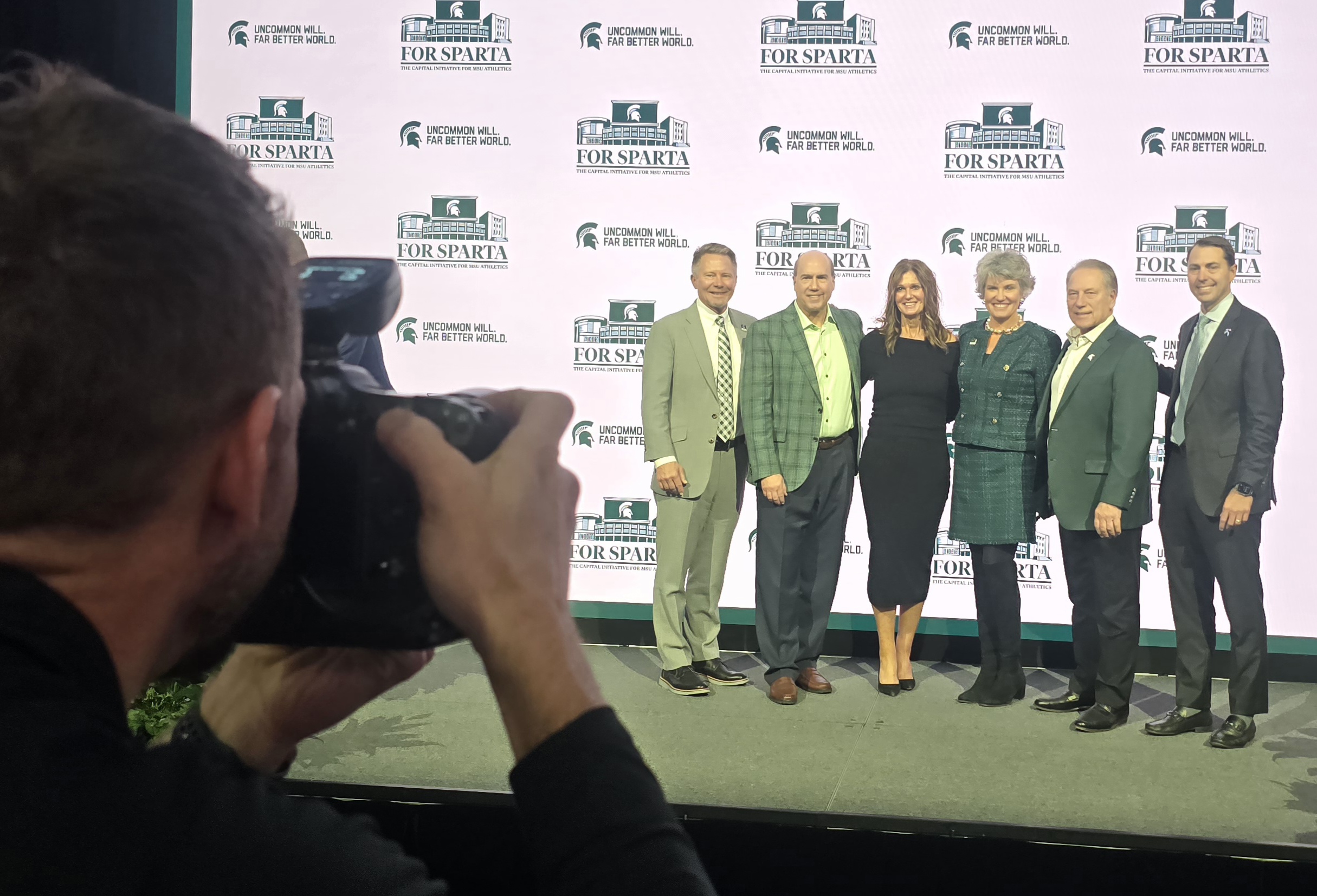
Reporters filed out to write stories. Coaches posed with Greg and Dawn and the university's senior leadership for pictures.
Lots of hugs, lots of well wishes. Band members mingling with the newly hired football coach. The tennis coach posing in front of Greg and Dawn. The gymnastics coach smiling next to the athletic director. Everyone was acutely aware that this donation was going to help them all meet their goals.
Outside Breslin, alumni called one another. Fans texted screenshots of the announcement. Social media blew up.
The future looked different now.
Greg and Dawn Williams had chosen Michigan State - not because they were alumni, not because of obligation, but because they believed in the institution’s people, purpose, and potential.
They believed in students who haven't been born yet.
They believed in athletes who haven't signed yet.
They believed in the idea that a university, at its best, is a force multiplier for the common good.
On this historic morning inside the Breslin Center, the horizon didn’t just open wider. Michigan State stepped toward it, with gratitude, purpose, and momentum unlike anything the university had ever seen.
And with a reminder – spoken by each speaker in their own way – that the future is no longer something that Spartans wait for. It is something Spartans go and build.
This gift is about ensuring that all the stories sports create – the connections, the memories, the victories, the road behind us and the one still ahead – have the support they need to keep going.
People who want to criticize can relax; it’s not their burden to carry. How someone chooses to invest their own money, especially in ways that strengthen a community and preserve something so many people love, is nothing worth worrying over.
At the heart of it, this is simply about sustaining a legacy so future generations can experience the same moments that have shaped all of us.
And as thousands of Spartan families make their way to games, matches, and competitions in the years ahead – walking through the same metaphorical (and literal) doors Greg and his daughter once did – this day will be remembered as the moment Michigan State didn’t just change its future.
It will be remembered as the day a university rediscovered what it can build when connection becomes purpose, and purpose becomes legacy.
A moment born from a father and daughter who simply needed a place to talk – and ended up helping reshape the place where generations of Spartans will come together next.