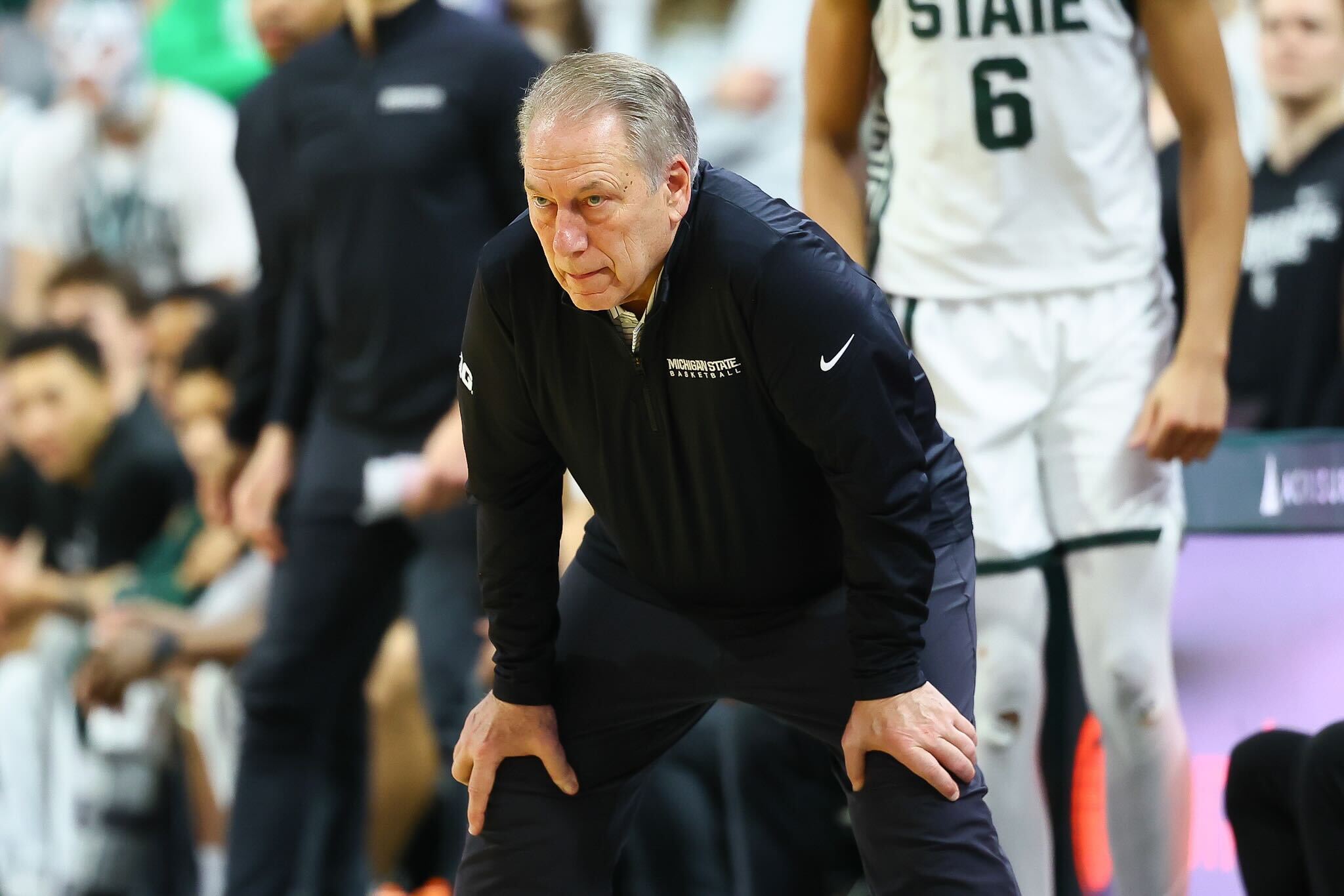
Behind the Scenes: How and why Tom Izzo refused to take Dusty May’s bait during a week of manufactured drama
Jeremy Fears was backed, then challenged, and - in the end - trusted by his coach
For most of the week, the story around Michigan State men's basketball wasn’t about ball screens or defensive rotations.
It was about a rival coach choosing to speak publicly about a Michigan State player days after a rivalry game. It was about speculation over what discipline might be doled out. It was about whether outside pressure – and outside messaging – could seep into a Spartan locker room at the worst possible moment for this team.
And it was about whether Tom Izzo would let any of it influence how he coaches his team.
He didn’t.
After a week of distractions, public commentary, and deliberate attempts by the University of Michigan basketball coach to shape a narrative from the outside, Izzo did exactly what he has done for three decades: he coached his team, protected his locker room, and didn't let anyone else take even a little control of his team or his approach.
When you look at the past week, you can tell it was about more than just Jeremy Fears – it was about whether a rival coach could use the media to drive a wedge into Michigan State’s locker room. About whether public pressure could fracture the trust Izzo has spent decades building inside his program. About whether Izzo could be nudged – or bullied – into disciplining a player to satisfy someone else’s storyline.
To the delight of Spartan fans who have been asking for MSU leaders to stand up to Michigan, Izzo shut that door completely. By refusing to act publicly, immediately, or performatively, he sent an unmistakable message: no one outside his program will set its course. No one besides him will dictate its discipline. And no one gets to coach Michigan State through a microphone.
If criticism comes with that stance, Izzo accepts it.
"What is reported is always different than what actually happened," Izzo said Friday. "And this whole thing started with the (Michigan) game – which I think some of that was blown out of proportion."
The flashpoint came when Michigan head coach Dusty May used a press conference – a few days after the rivalry game – to publicly comment on the actions of Michigan State guard Jeremy Fears Jr..
The timing wasn’t incidental. By addressing the situation publicly days after the game, May introduced a storyline that was bound to take on a life of its own. Once it entered the public space, the focus shifted quickly to interpretation and reaction, rather than a broader examination of the physicality on both sides during the rivalry game.
Rivalry games are physical. They always have been. Watch the film from that Michigan game and you’ll see just as many Michigan players attempting plays that could have injured Michigan State players as the reverse.
"I don't condone anything a player does to put another player in jeopardy of being hurt," said Izzo. "There's going to be things that go on in a game on both sides that happen, and competitors are going to compete."
That’s Big Ten basketball. Bodies collide. Competitors compete. That's normal.
What isn’t normal is revisiting those moments days later, through the media, with accusations about intent. You'd be hard-pressed to find many coaches publicly calling out another team's players, especially without having first privately addressed it with the coach in question.
"(This is) about my team and my decision," said Izzo. "(Anyone) can create (their) own philosophy on whether it's right, wrong, or indifferent. But I promise you this – (the Fears situation) is not nearly what it was made out to be in the first place."
Again, most of the time, coaches handle these things privately. They pick up the phone. They talk coach-to-coach. They sort it out behind the scenes and move forward.
That obviously didn’t happen here.
Instead, the conversation was dragged into public view by the new guy in Ann Arbor – a move that invited speculation, amplified outrage, and attempted to force Michigan State’s hand.
From the moment the questions began, Izzo didn't accept the premise. Not only did he reject the framing outright, he pushed back on it.
Any suggestion that his decisions would be influenced by a rival, by media pressure, or by optics was shut down immediately. Discipline, if any, would have “nothing to do” with appeasing anyone else.
Izzo made clear he had looked at everything – not one clip, not one angle, not the version most convenient for television. He acknowledged what he didn’t like. He acknowledged the need for growth. But he flatly rejected the suggestion that this was about trying to injure someone, calling that characterization insulting and untrue.
"I did not like the backward kick (at Minnesota)," Izzo said. "He was pushed (then) he did that (and) sometimes those are reactionary. (But I asked myself), did I talk to him enough (after the UM game)? And so the next day I had a come to Jesus meeting with him, again, and I think he understands what's going on (now)."
Izzo wasn’t defending recklessness. He was defending fairness. He knows that you don’t evaluate a player by isolating a single moment and ignoring the rest of the resume. You look at the whole picture.
In Fears’ case, that picture matters. A strong student. No off-the-court issues. No classroom problems. No drugs. No alcohol. No pattern of behavior. A competitor who sometimes plays on the edge, but who has grown significantly since arriving in East Lansing.
Izzo didn’t dodge the hard part. Fears still has growing to do. He said it plainly – “Does he have to grow up? 100%.” He also said that growth is already happening.
"I'm going to deal with the facts, and I'm going to handle it accordingly," said Izzo. "And I already have. If you don't think this has already been handled, it has been handled. But if you think I'm going to give in to let you think that I've got some loose cannon here, when the guy does 95% of everything right, not only his play, but his off the court, he's in the classroom. His body of work deserves something. And I'm the only one that knows that. And I'm ready to be taken to task like I was last week, like I may be today, or like I may be tomorrow. I will make the best decision for that kid first, and for me and my program second."
And Izzo drew the clearest line of all: if he believed Fears was trying to injure someone, he wouldn’t be playing. Period.
Inside the locker room, accountability was never avoided.
Fears took responsibility with his teammates. He owned what happened. He understood how moments can be framed, replayed, and used against a team. He has said he knows his coaches and teammates trust him – and that trust carries responsibility.
He also understands he can’t put himself or his team in situations that can be weaponized or turned into distractions. That message landed internally.
Saturday night, when Izzo decided that Fears would start against Illinois, he was explicit about one thing – this had already been handled. Fully. Privately. Without theatrics.
He refused to let a public narrative redefine one of his players. Players make mistakes. Coaches coach them. They don’t abandon them for headlines.
“I’ll coach my team,” Izzo said. “Other people can coach their team.”
When Michigan State tipped off against Illinois Saturday night, the Spartans looked like a group that had already resolved everything that needed resolving.
They defended with purpose. They played connected basketball. They trusted one another. And when the moment demanded resolve, they responded.
The win did more than boost their NCAA tournament resume. It ensured a two-game losing streak didn’t become three. It stabilized a moment that could have tilted the season. And it confirmed that Izzo's approach to the noise happening outside the program was effective in making sure it never found its way inside the locker room.
This was never about winning a press conference. Izzo didn’t let a rival define the moment. He didn’t let the media define his player. He didn’t let outside pressure seep into his locker room. He made the decision he believed was right for his player first, and for his program second – exactly as he said he would.
"I'll coach my team, other people can coach their team," Izzo said Friday. "I don't say anything about anybody else's team that I don't know about the individual. And people want to say something about mine, that's all good, but it ain't going to change my opinion of my guy. Jeremy Fears has gone through a lot since he's been here, more than most people go through in a college lifetime. And, you know, I've been critical of him a lot. I've watched him grow. I like the trajectory he's growing at. If there's a couple of rough edges, I'm going to curb them, just like I have many before him."
All eyes are going to be on Fears for awhile as he navigates through this. Saturday night, after the game, Illinois head coach Brad Underwood was asked about a play he requested to be reviewed that involved Jeremy Fears stopping and an Illinois player tripping over him from behind.
"There was nothing on the trip," Underwood said. "(The refs) looked at it. (Fears) stops and it's what he does. He was terrific. He's crafty, he's smart and he did a nice job tonight."
If there was any lingering question about whether Izzo was going to allow this storyline to keep breathing, it disappeared after the final buzzer against Illinois as Izzo was addressing the media on the second level of the Breslin Center.
A reporter requested the mic and asked Izzo whether he felt relieved that Illinois head coach Brad Underwood was unsuccessful when he requested a review involving Jeremy Fears during the game.
“How relieved were you that Underwood didn’t get the appeal on Fears?” the reporter asked.
“I don’t know, Larry, you’re the only guy that would ask that question,” Izzo replied directly. “I have no idea. I didn’t go over there. If (Fears) breathes on somebody, now there’s gonna be a call thanks to what happened. So end of that story. Ask me another question – you won’t get an answer. Next.”
And with that, it was over. No relitigation. No indulging hypotheticals. No letting one more question turn into another attempt to reshape a player or reopen a situation Izzo believed had already been handled. He coached his team. He protected his locker room. He won the game. And then he moved on – on his terms.