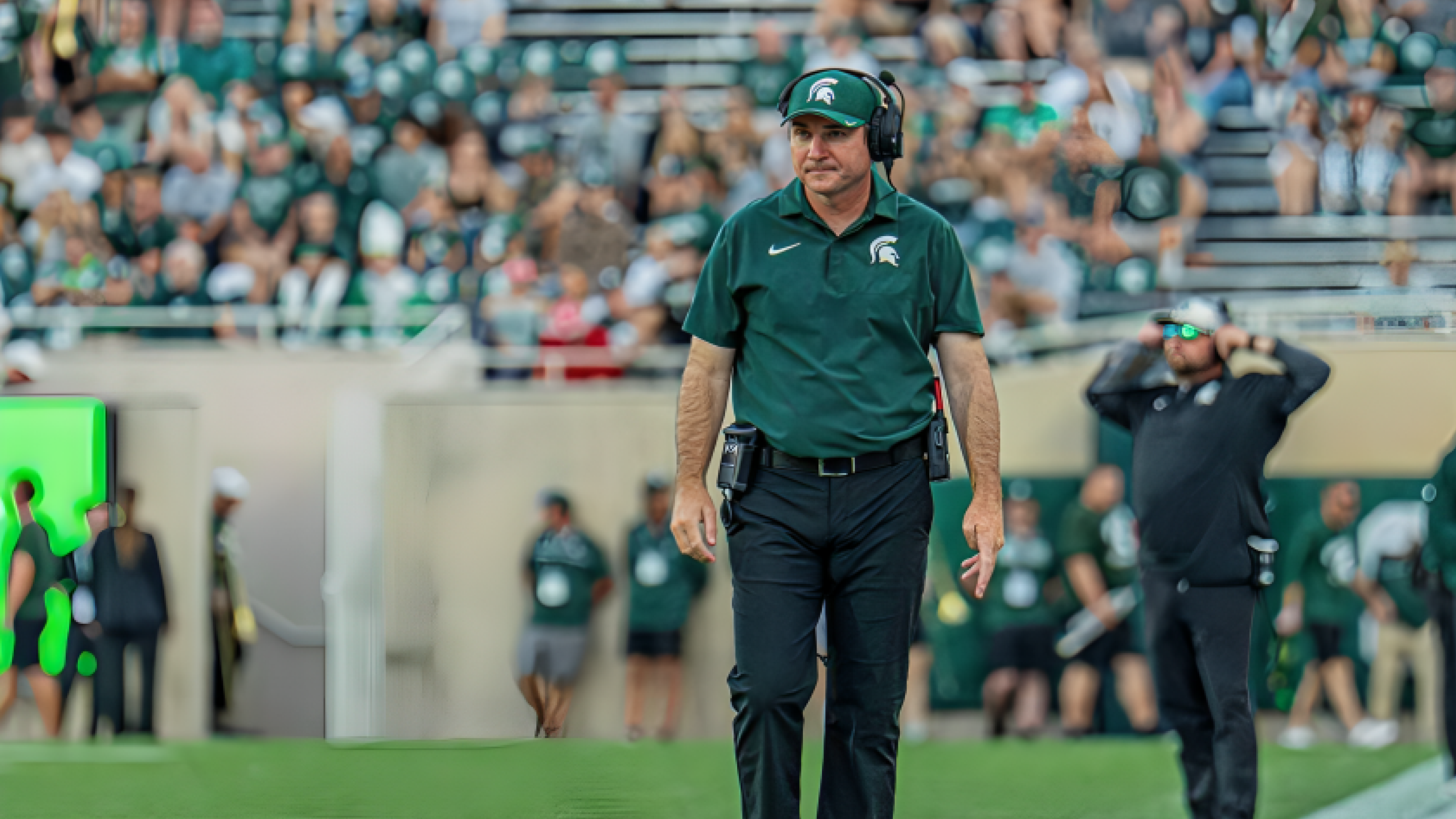
Inside Smith’s Contract: What happens if he’s fired without cause
Details and analysis here.
When Michigan State hired Jonathan Smith in late 2023 to rebuild a football program reeling from turmoil, the university also inked one of the most carefully structured contracts in school history.
Beyond its seven-year, $52.85 million value ($44,922,500 of which was guaranteed unless he was fired for cause), the agreement includes precise terms governing what happens if Smith is dismissed “without cause” - a provision that protects both the coach and the university in the unpredictable world of college football.
Section 6.2 of the contract makes clear that Michigan State may terminate Smith’s deal “at any time, for any or no reason,” by giving written notice. In that event, Smith is entitled to significant compensation - but with important conditions attached.
If fired without cause, Michigan State must continue covering Smith’s health insurance for three full months and pay him 85 percent of his remaining base salary and supplemental income for the rest of the contract term. That payment, known as “liquidated damages,” is made in equal monthly installments and includes all required tax withholdings. Smith would also receive any earned but unpaid performance bonuses. However, these payments depend on him signing a formal release and separation agreement prepared by the university.
I am not a contract lawyer but, by my math, MSU would owe Smith $31,556,250 if he is terminated before 2/1/26. That number drops to $25,415,000 after 2/1/26. The nearly $32M would be payable in 62 monthly payments of $508,972 from December 2025 through January 2031.
The contract also imposes a duty to mitigate - meaning Smith must make a genuine effort to find another comparable coaching job. Specifically, he’s required to “actively seek and obtain” employment as either an NFL or Division I head coach within a reasonable time. He is not required to take any position that he determines, “upon reasonable judgment,” isn’t in the best interest of his career - but he also can’t delay or structure new compensation in a way that avoids offsetting his MSU payments.
If Smith secures a new job, he must promptly notify Michigan State and provide full documentation - including his new contract, total compensation, and start date. “Total compensation” is defined broadly to include not only base salary but also deferred pay, bonuses, and other supplemental earnings. If the new job pays less than what he would have earned from MSU, the university must make up the difference, either as reduced monthly payments or a lump sum. If the new position pays more, Michigan State’s payment obligation ends immediately.
If Michigan State fires Smith without cause, prior to 2/1/26, the Spartans will be on the hook for the $500k per month, but that amount will be reduced after Smith "seeks and obtains" employment in the NFL or D-1 college. If, for example, Smith is hired at another university for $2.4 million per year ($200k per month), Michigan State's $500k per month payment would be reduced to around $300k per month for the duration of the payout.
The clause also allows MSU to suspend payments if Smith fails to provide required documentation of his new employment.
In a unique protection for the university, Section 6.2 extends even beyond termination. If, within one year after Smith’s dismissal, Michigan State discovers that he engaged in conduct during his tenure that would have qualified as “cause” for firing - meaning behavior that violated his contract or university policy - he must repay any money received under the termination provision. The clause explicitly survives the end of the agreement, ensuring that any later findings of misconduct could nullify the payout.
In practical terms, this means Smith’s financial safety net is strong - but not absolute. The university would owe him the bulk of his remaining guaranteed compensation if he’s let go without cause, but those payments would stop or shrink once he finds a comparable job elsewhere. It also gives MSU legal recourse to reclaim funds if post-employment investigations uncover misconduct that would have justified a “for-cause” firing.
Such clauses have become increasingly standard in modern college football contracts, but Michigan State’s version is unusually thorough. It reflects lessons learned from the school’s recent history - particularly the fallout from Mel Tucker’s firing for cause in 2023, a case that turned on the fine print of similar contractual language.
Jonathan Smith’s deal shows how Michigan State tried to strike a balance in its contract with Smith: providing him with stability and financial protection, while also safeguarding the university from the full financial weight of another major buyout.
As mentioned in my article published on October 9th, this decision by new Athletic Director J Batt will have a major impact on the future of Michigan State Football.
If you value detailed insider reporting and access to information like this, please support independent MSU coverage by subscribing to Spartans Illustrated. Not only does your subscription keeps stories like this coming, but a percentage of every subscription also supports the Michael Sadler Foundation, continuing the legacy of one of Michigan State’s greats. Please click here and subscribe today.
Firing Smith (and his staff) early would likely run close to $37 million. A proven replacement, however, would ask for even more guaranteed money to come into a program which will no doubt implode if Smith is fired this season.
Here are eight things to consider when trying to determine if firing Smith will result in an immediate turnaround of the MSU Football program:
If Smith leaves, so does a significant portion of the team, including the most likely gutting of a decently ranked 2026 recruiting class.
This is an incredibly tight team and retention of the current team will be difficult. Very, very few productive players will stay.
Most everyone on the team right now is bought into the culture. They believe in what Smith is selling.
If you want to keep Chiles and Marsh next year, the way to make sure that doesn’t happen is to fire Smith.
Sources say firing Smith after this season would be “catastrophic” to the short and medium term results of the program.
If you fire Smith, you have to hope that the new coach brings in an entire team with him. And, unfortunately for those who support this approach, the Cignetti Model...