
There is always danger in treating four games of college football as though they represent a finished statistical profile, and UCLA may be an even better example than most. The Bruins are 4-0, have demolished their first two Big Ten opponents and have produced some of the most efficient rushing numbers in the country, but they have not faced anything resembling Oregon’s combination of roster talent, defensive-line depth and offensive weaponry.
Oregon presents the same analytical problem from the opposite direction. The Ducks are 3-1 and just produced their best offensive performance of the season at USC, but the FBS-only data still carries the damage from Oklahoma State while most opponent-adjusted systems remove the 84-0 Portland State game entirely. Depending upon which model we choose, Oregon can look like a top-10 team, a top-20 team or something considerably less convincing on a down-to-down basis.
That disagreement is what makes this matchup analytically interesting. FEI ranks Oregon ninth nationally and UCLA 34th, F+ has Oregon ninth and UCLA 27th and SP+ sees enough separation to place the Ducks around the current double-digit point spread at Autzen.
Game on Paper complicates that comfortable picture considerably. Its FBS-only adjusted EPA model currently has UCLA slightly ahead of Oregon in net efficiency, while the Bruins own a dramatically stronger success-rate differential through their first four games.
Those numbers do not automatically make UCLA the better football team, but they are too substantial to dismiss simply because the jerseys say Oregon and UCLA. The real question is whether the Bruins’ first month represents a genuine new baseline under Bob Chesney or whether September efficiency is about to meet an opponent capable of changing the terms. The answer starts with one major statistical contradiction.
The numbers start with a contradiction
UCLA has been considerably better than Oregon at producing successful plays, yet almost every broader opponent-adjusted system still prefers the Ducks. That is not a minor disagreement around the edges; it represents two fundamentally different ways of interpreting what these teams have accomplished.
The snap-by-snap data loves UCLA because the Bruins have repeatedly stayed ahead of schedule, particularly on the ground. Their net efficiency is excellent, their success-rate differential is among the best in the country and a high percentage of their offensive snaps are producing the result needed to make the next play easier. FEI and F+ see more separation because they are giving greater weight to opponent quality and possession-level performance. FEI rates Oregon eighth offensively and 19th defensively compared with UCLA at 24th and 51st, while F+ arrives in nearly the same neighborhood with Oregon eighth offensively and 21st defensively against UCLA at 21st and 45th.
The two perspectives are not really arguing over what happened. They are arguing about how much of what happened should be expected to continue when the quality of opposition changes.
That distinction matters Saturday because UCLA has played efficient football against the teams it was asked to play. Oregon now represents a level of defensive athleticism, offensive talent and overall roster depth the Bruins have not yet had to solve.
The most important part is understanding why the snap-by-snap models like UCLA so much. It is not because Nico Iamaleava has turned into one of the country’s most efficient dropback passers or because the Bruins suddenly possess an elite vertical passing attack. The explanation begins with the running game, and almost everything else UCLA does grows from there.
Oregon offense vs. UCLA defense: the matchup the Ducks have to win
This is the side of the football where Oregon should possess its cleanest opportunity to control the matchup, even though UCLA’s surface-level defensive numbers look considerably more intimidating than the deeper profile. The Bruins are allowing fewer than 20 points per game, have intercepted eight passes and have been good at forcing offenses into inefficient downs. Opponents have struggled to sustain successful plays against UCLA, particularly through the air, and the Bruins have created enough havoc to repeatedly alter possessions before they reach scoring territory. None of that production should be dismissed simply because the opponent-adjusted rankings are less enthusiastic.
Those broader models do add important context, though. Game on Paper places UCLA’s defense much closer to the national middle than the scoring average would suggest, while FEI and F+ both see a unit closer to good than elite once the quality of opposing offenses is accounted for.
The strangest piece sits inside the passing numbers. UCLA has allowed opposing quarterbacks to generate substantial yardage per dropback while still producing poor overall EPA, which would normally appear contradictory if not for the Bruins’ interception total. That is where the defensive story changes. UCLA has frequently allowed an offense to create several useful plays and then erased the value of the entire possession with one takeaway.
Maryland was the extreme example because four interceptions and two defensive touchdowns transformed the scoreboard without requiring UCLA’s defense to dominate every snap. The Bruins did not simply make Maryland inefficient; they repeatedly turned Maryland possessions into UCLA possessions and, on two occasions, into UCLA points.
That is why Oregon’s most important offensive statistic may still be zero. The Ducks’ quarterbacks have not thrown an interception this season, while UCLA’s 4-0 start has been built in significant part around forcing opponents into exactly that mistake. If Oregon refuses to provide it, the Bruins suddenly have to defend the Ducks for entire possessions. That becomes a much more difficult assignment because Oregon has generated substantially more offensive value throwing the football than running it against FBS competition.
The passing game has been the clearest strength in Drew Mehringer’s offense even when Oregon’s overall success rate has remained more ordinary than the scoring average suggests. USC provided the best example of what happens when protection, quarterback decision-making and receiver talent all line up at the same time. Oregon produced enormous value through the air in Los Angeles, averaged more than 10 yards per dropback and did not surrender a sack. The Ducks were not dominant running the football, but they remained credible enough on the ground that USC could never completely organize the defense around stopping the pass.
That should be the objective again Saturday because Oregon does not need to prove it can physically overwhelm UCLA’s strongest defensive area. The Ducks need enough useful rushing production to keep the possibility of the run alive and prevent the Bruins from turning every meaningful down into a protection test. Second-and-5 preserves almost everything in Mehringer’s playbook. Second-and-10 gives Sammy Omosigho and UCLA’s pressure package significantly more freedom because the defense can begin eliminating possibilities before the ball is even snapped.
That is why Oregon’s rushing total may ultimately tell us very little about whether the ground game succeeded. The more important question is whether those carries continue protecting the ambiguity that makes the Ducks’ passing game harder to defend.
UCLA offense vs. Oregon defense: the matchup that can change the entire game
This side of the matchup is considerably more uncomfortable for Oregon because UCLA’s rushing attack has not merely been productive through four games. It has been one of the most efficient rushing offenses in college football. Wayne Knight is averaging more than nine yards per carry, but the success rate underneath that average is what makes him especially dangerous. More than 60% of his attempts have produced a successful outcome based upon down and distance, meaning UCLA is not simply receiving a few explosive runs surrounded by unsuccessful carries.
Knight is consistently improving the next play.
The rest of the backfield reinforces the same problem. Anthony Woods has produced well over seven yards per carry, Jaivian Thomas has remained efficient and Iamaleava gives Chesney another runner Oregon has to account for before the ball is snapped. That is what UCLA really is offensively. Iamaleava has been solid enough throwing the football, but his passing efficiency has been far more ordinary than the extraordinary value UCLA creates on the ground.
Chesney has therefore done something important with his quarterback. He has stopped requiring Iamaleava to become the entire offense and instead built a structure where the quarterback can benefit from favorable downs created by everybody around him. Second-and-4 is an entirely different quarterback environment than second-and-10. Play action remains believable, the quarterback run remains available, the RPO game can manipulate linebackers and the defense cannot simply turn the front loose because it still has to honor almost everything in the playbook.
That becomes particularly concerning for Oregon because the Ducks’ weakest statistical area lines up directly with UCLA’s greatest strength. Oregon has allowed close to five yards per rush against FBS competition, positive EPA on opponent carries and a rushing success rate much higher than Chris Hampton would want from a defense with this much talent up front. Oklahoma State remains the obvious warning because the Cowboys did not merely run efficiently with their backs. Drew Mestemaker became part of the rushing problem as well, producing 109 yards and turning one missed responsibility into a 75-yard touchdown.
UCLA has watched that film, and its quarterback run game does not need to emerge accidentally. Iamaleava is intentionally part of the offensive arithmetic, giving Oregon one more defender to account for while simultaneously trying to prevent Knight from reaching the second level. Therefore, Oregon does not need to completely win the rushing matchup to change the game. Knight probably is not going to finish Saturday averaging three yards per carry, and setting that as the standard would ignore what UCLA has consistently demonstrated.
The Ducks just need to turn enough eight-yard gains into four and enough second-and-3 situations into second-and-7. Do that repeatedly and the Bruins eventually have to expose more of the passing game, which is precisely where Oregon’s defensive front can begin playing more aggressively. That is also where the opponent adjustment becomes important. FEI still views Oregon as a top-20 defense despite some ugly raw drive statistics, while UCLA’s offense drops considerably once the quality of opposing defenses is accounted for.
Saturday provides the cleanest possible test of both interpretations. If UCLA continues running at anything close to its September efficiency, the Bruins’ underlying numbers deserve to be taken very seriously going forward. If Oregon substantially reduces that efficiency, the broader models will have had a point. The Bruins may still be good without being quite as overwhelming once the level of competition changes.
The strangest statistical matchup: UCLA allows passing yards and still wins the possession
The more I watch UCLA’s defense, the more I return to how much passing yardage the Bruins can surrender without allowing that production to become meaningful scoring value. The relationship looks strange until the interception total is placed beside it. A 20-yard completion produces positive value for an offense. Three productive plays followed by an interception can erase most of that value immediately, and UCLA has spent September repeatedly turning otherwise functional possessions into exactly that kind of negative event.
That makes Saturday a philosophical test for Oregon because the Ducks cannot allow UCLA’s turnover numbers to frighten them away from the portion of the defense most vulnerable to attack. Mehringer should not ask the quarterback to become reckless, but extreme caution could end up helping UCLA almost as much as an interception does. Oregon has enough receiving talent to challenge UCLA at every level of the field and enough evidence through four games to trust the decision-making at quarterback. The Bruins should have to defend that talent rather than receive a more conservative Oregon passing game simply because Ta’Shawn James has three interceptions and the defense has eight overall.
The correct offensive mindset is therefore more nuanced than merely protecting the football. Oregon needs to remain aggressive when the matchup calls for it while refusing to turn a good opportunity into a low-percentage throw that allows UCLA to erase an entire possession. That balance may determine whether UCLA’s pass defense looks like the unit allowing substantial yardage or the unit producing negative EPA. Both versions exist inside the same statistical profile, and Oregon can influence which one appears Saturday.
The hidden mismatch Oregon may be able to exploit
UCLA’s defense has been significantly better against the run than the pass, which makes Oregon’s receivers against the Bruins’ secondary the obvious matchup. The more interesting hidden matchup involves what happens when UCLA attempts to help that secondary by attacking the quarterback with Omosigho and its linebackers. Omosigho has been one of the most disruptive linebackers in the country through the first month. His 37 tackles, 7.5 tackles for loss, three sacks and four forced fumbles only begin to describe the freedom UCLA gives him to attack the line of scrimmage.
Lanning has already talked about the way the Bruins use their linebackers almost like defensive linemen at times. UCLA can threaten one gap, bring pressure from another and force the quarterback and offensive line to determine which defenders are actually part of the rush. That aggression also creates space because every linebacker moving toward the quarterback is vacating somewhere else. Oregon showed at USC that a running back can become part of the answer when Hill turned four catches into 105 yards without forcing the Ducks into a specialized personnel package.
That becomes particularly valuable against UCLA because Oregon does not have to solve Omosigho exclusively by blocking him. The Ducks can account for his pressure by delivering the ball into the area he vacated, making the aggressiveness itself part of the offensive opportunity. If Oregon does that repeatedly, UCLA eventually has a decision to make. The Bruins can continue sending one of their best defensive players downhill and accept the space behind him, or they can reduce his pressure responsibility and make the rest of the front create disruption without him.
Either outcome helps Oregon because it changes the version of UCLA’s defense the Ducks have to solve. That is the type of advantage hidden beneath the traditional box score: Oregon does not necessarily need to defeat Omosigho physically if it can make his greatest strength expensive enough that UCLA has to use it differently.
The defensive number Oregon cannot ignore
The UCLA offensive number that matters most remains the value generated every time the Bruins run the football. That efficiency is substantial enough to turn a double-digit favorite into a team spending the fourth quarter protecting a one-possession lead. The concern is not merely the possibility that UCLA rushes for 250 yards. The larger problem is how those rushing yards alter the clock, down and distance and the number of defensive answers Oregon has available.
A five-yard first-down run reduces Hampton’s options without ever appearing on a highlight reel. Another productive carry on second down can create third-and-short, where Oregon still has to defend Knight, Iamaleava, the RPO game, play action and a conventional dropback pass. Repeated often enough, that structure forces Oregon to react rather than dictate. That was one of the largest problems at Oklahoma State, where the Cowboys kept arriving at the next snap with enough possibilities available that Oregon rarely controlled the terms.
The Ducks have now had four games of evidence and a bye week devoted partly to self-scouting. Lanning has already emphasized that UCLA’s backs are often getting several yards downfield before first contact and that Knight is especially difficult to finish once that contact finally occurs. That creates two separate battles inside every UCLA rushing attempt. Oregon first has to move the location of contact closer to the line of scrimmage, then it has to finish the tackle rather than allowing Knight to convert contact into several additional yards.
Solving only one of those problems will not be enough. UCLA’s efficiency is built upon both the space created before contact and the production its backs generate afterward.
The model disagreement is telling us something useful
This matchup is analytically different from USC because the major systems broadly agreed that Oregon and the Trojans were close. They disagree much more dramatically about UCLA.
FEI sees a substantial separation between Oregon and UCLA, while F+ also gives the Ducks a meaningful advantage. The broader predictive systems consistently view Oregon as the better overall team once opponent quality and possession efficiency are included.
Game on Paper sees something much tighter because its snap-by-snap FBS data rewards the consistency UCLA has demonstrated. The Bruins’ success-rate differential is much stronger, and their net adjusted EPA profile compares favorably with Oregon’s through the first month. That disagreement is useful because the models are essentially testing two competing theories about UCLA. One says the Bruins have already become a genuinely high-level team under Chesney, while the other says the performance has been excellent but has occurred against a schedule that does not justify treating UCLA as Oregon’s equal yet.
The market has effectively positioned itself between those interpretations. Oregon opened around a 12-point favorite and has generally settled closer to 11.5, while the total has moved downward from roughly 60 into the upper 50s. Both movements make sense to me because UCLA deserves respect, but the way the Bruins play also creates fewer opportunities for Oregon to establish a large margin. A team committed to running the football and reducing possessions can make a favorite work much harder to create separation even when the favorite remains more likely to win.
That distinction becomes important once we move from predicting the winner to evaluating the number.
What I expect the game to look like
I expect UCLA to tell us almost immediately whether Oregon corrected anything during the bye because Chesney has very little incentive to disguise his intentions. Oregon has placed enough run-defense vulnerability on film that the Bruins should make the Ducks demonstrate they have changed before moving significantly away from their greatest strength. That does not mean UCLA has to open with 12 consecutive runs. The running game can remain the question underneath almost everything Chesney calls, with Iamaleava reading Oregon’s second level, Knight testing the interior and edges and formation changes forcing the Ducks to continually reset their responsibilities.
If Oregon begins creating contact near the line and producing second-and-long, the script changes naturally. Iamaleava becomes a larger piece of the offense, UCLA loses some of its run-pass ambiguity and Oregon’s defensive front gains more opportunities to rush without simultaneously accounting for every possible run fit.
Oregon’s opening offensive possessions should have a different purpose. Mehringer has reason to test UCLA’s secondary early, but the Ducks do not need to turn the first quarter into a collection of low-percentage vertical throws to accomplish it. The smarter approach is making UCLA declare what it wants to protect. Oregon can take the seven-yard completion, involve the backs when linebackers pressure and force the safeties to reveal how aggressively they intend to participate in the run before beginning to hunt larger plays downfield.
That could make the first half feel more deliberate than Oregon-USC because neither team has an obvious reason to manufacture possessions. UCLA wants to run, Oregon wants to maintain balance and both teams should understand that a turnover carries unusual value in a game with fewer total drives. The second half is where Oregon’s roster advantage should become more visible if the Ducks have avoided giving UCLA extra possessions. Oregon can continue rotating defensive linemen, continue presenting different offensive weapons and force UCLA to solve new problems after spending three quarters dealing with the original ones.
That does not mean UCLA simply fades because Chesney has specifically built this team to remain effective late. It means Oregon should possess more alternative pathways once fatigue and adjustments begin reducing the effectiveness of everybody’s first plan.
Six names the analytics keep pointing toward
UCLA offense
Nico Iamaleava matters precisely because Oregon should want him to become more important as the afternoon progresses. His passing profile has been far less efficient than UCLA’s rushing attack, which means a game with 35 meaningful Iamaleava dropbacks would probably indicate Oregon has already moved the Bruins away from the conditions they prefer. He still has enough arm talent and athleticism to punish poor discipline, so Oregon cannot simply dare him to throw. The objective is making his arm carry more of the offensive burden without creating the easy play-action opportunities that come from UCLA dominating first down.
Wayne Knight is the statistical center of the entire matchup because his production combines explosiveness with extraordinary consistency. Oregon does not need to erase him, but it has to make him work substantially harder for the successful downs UCLA has received almost automatically through four games. The difference between Knight gaining four and Knight gaining eight goes far beyond four yards. One keeps Oregon’s defensive options intact, while the other allows Chesney to return to the next snap with almost his entire offense still available.
Semaj Morgan becomes increasingly important if Oregon succeeds against the run because somebody has to occupy the space created when UCLA shifts more responsibility toward Iamaleava. Morgan leads the Bruins in receiving and works primarily from the slot, giving UCLA an accessible answer if Oregon’s linebackers become overly aggressive trying to solve Knight. His raw receiving totals are modest because UCLA has not needed much passing volume. That could change quickly if Oregon forces the Bruins into the game it prefers.
UCLA defense
Sammy Omosigho is the defender Oregon has to identify before almost every snap because his influence extends well beyond his tackle total. UCLA can use him as a conventional linebacker, an attacking pressure player or part of a front designed to confuse protection responsibilities. Oregon cannot allow that versatility to dictate every important down. The Ducks have to block him when necessary, account for him when he pressures and attack the space he leaves when UCLA becomes too aggressive.
Ta’Shawn James explains why Oregon cannot confuse available passing yardage with safe passing yardage. His three interceptions are part of a defensive structure that keeps eyes on the quarterback while pressure attempts to change the timing of the throw. Oregon should challenge the secondary because the opportunities exist, but the football cannot arrive late enough for James to convert aggression into exactly the possession-changing play UCLA wants. The passing advantage disappears quickly if productive yardage ends with the ball going the other direction.
Jalen Woods matters because UCLA’s second-level pressure package is not dependent upon Omosigho alone. Woods gives the Bruins another experienced linebacker capable of fitting the run, dropping into coverage or becoming part of the pressure structure. Every time Oregon forces Woods and Omosigho to hesitate between those responsibilities, the offensive picture becomes clearer. The goal is not merely preventing UCLA from making plays; it is keeping the Bruins from confidently knowing which kind of play they should be trying to make.
The analytics prediction
There are several reasonable ways to model this matchup, and almost all of them place Oregon somewhere between a comfortable favorite and a team that should not quite be laying two touchdowns. SP+ sits near the current market, while the FBS-only efficiency data produces a tighter matchup and FEI and F+ create greater separation once opponent quality becomes part of the calculation.
My blended number lands slightly below the market because UCLA’s preferred offensive style attacks the part of Oregon’s defense I trust least. That matters even if Oregon still owns the better roster and remains considerably more likely to win.
A team capable of producing successful rushing plays at UCLA’s rate can reduce the total number of possessions and make a favorite work harder to create separation. Every six-minute Bruins possession is another opportunity Oregon’s passing-game advantage never receives. The total presents much the same argument because UCLA operates comfortably through the run and has no reason to increase the number of possessions if the game remains competitive. The obvious danger to an Under is that turnovers, defensive touchdowns or explosive plays create short fields and quick scores that overwhelm the slower pace.
That keeps my projected total close to the market rather than creating a strong betting position. The spread remains more interesting because UCLA’s ability to shorten the game directly influences whether Oregon can create the separation required to cover a number above 11 points.
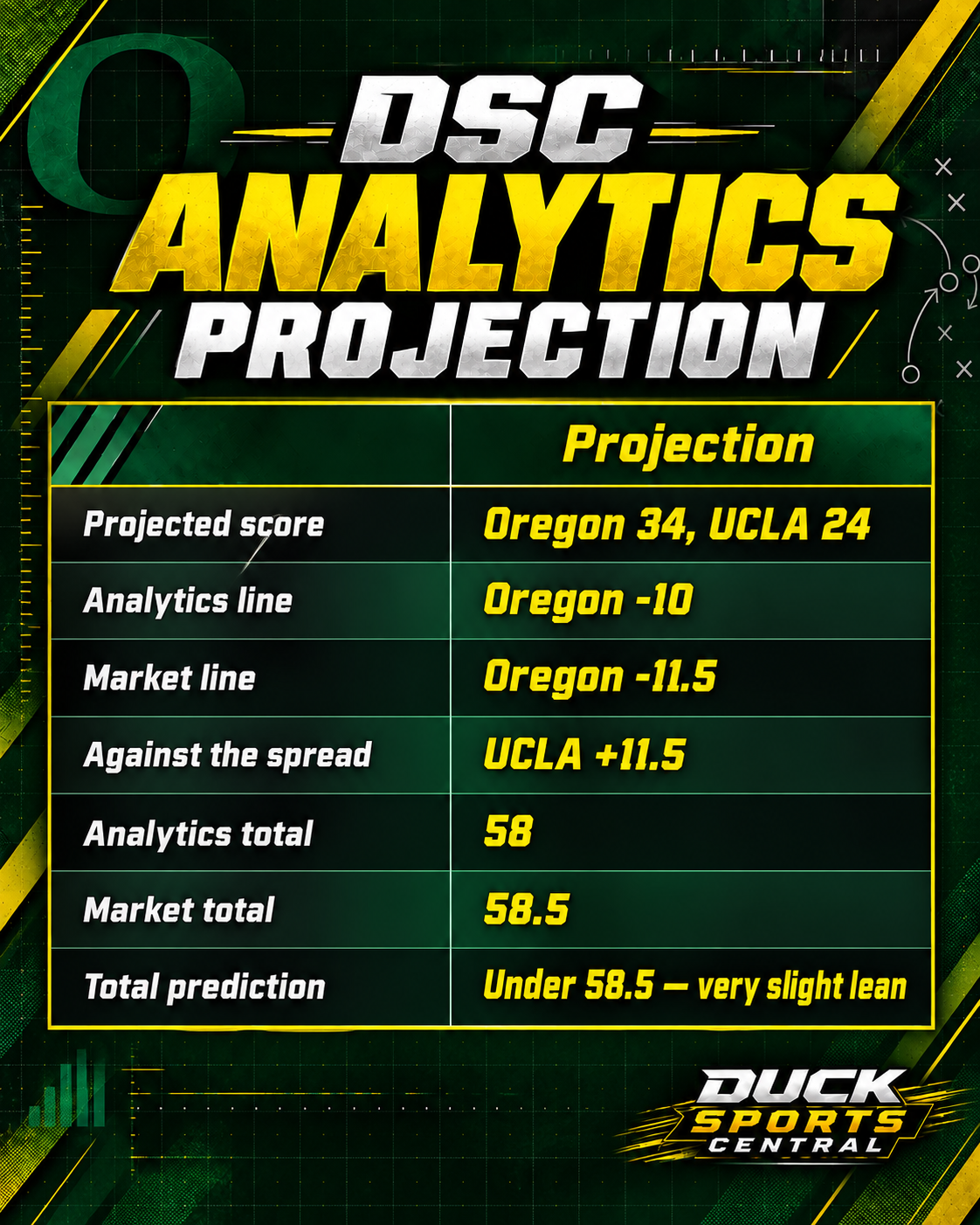
I would not take UCLA simply because the Bruins are undefeated and receiving double digits. The reason for the lean is much more specific: UCLA possesses the one offensive trait capable of compressing Oregon’s number of possessions, and its rushing efficiency attacks an actual Ducks vulnerability rather than something created merely to make the matchup sound competitive.
I still expect Oregon to win because the Ducks possess more answers when the original plan fails. UCLA has been exceptional at playing the game it wants, while Oregon already demonstrated at USC that it can lose its starting quarterback, watch a lead disappear and still find a different way to finish. The cleanest UCLA path requires Knight to keep the Bruins ahead of schedule, Iamaleava to avoid obvious passing situations and the defense to create at least one possession-changing turnover. If those three things happen together, this can remain a one-score game well into the fourth quarter.
Oregon’s path is broader because the Ducks can throw efficiently even if the rushing game is merely functional, survive some Knight production if they eventually win enough passing downs and force UCLA to sustain full-field drives rather than handing the Bruins the short fields that have accelerated the first four wins.
That is why the projection remains Oregon 34, UCLA 24. The score gives proper respect to what UCLA does exceptionally well without assuming four weeks of efficiency automatically erase the broader roster and opponent-adjusted advantages Oregon still possesses.
I expect UCLA to run the football well enough to make Oregon uncomfortable for portions of the afternoon, and I expect Knight to generate enough successful early-down carries that the Ducks cannot immediately dictate the game. I also expect Oregon’s passing game to eventually present a level of matchup stress UCLA has not yet encountered.
If Oregon continues protecting the football, the Bruins will have to defend the Ducks for complete possessions without relying upon the interception that has repeatedly erased opponents’ best work. If Oregon creates enough true passing situations defensively, Iamaleava will eventually be asked to become something UCLA has not needed him to be through four games. Those are the two pressures that ultimately move my projection toward Oregon. The Bruins have been remarkably good at keeping themselves inside their preferred game, but the Ducks possess more ways to function once the matchup moves somewhere else.
The market sees an 11.5-point favorite, Game on Paper sees two teams whose first four FBS performances are considerably closer than that and the broader predictive systems see a stronger Oregon team whose schedule has made some of its raw statistics look less impressive than its actual quality. My read lands between those positions, with Oregon winning but UCLA remaining just inside the number.
The Countdown therefore arrives at Oregon 34, UCLA 24, with UCLA +11.5 as the side and only a very slight lean toward Under 58.5. More importantly, the numbers suggest Saturday will tell us something we still do not know: whether UCLA’s extraordinary September rushing efficiency survives a championship-level roster or whether Oregon’s opponent-adjusted advantage finally begins showing up snap after snap.